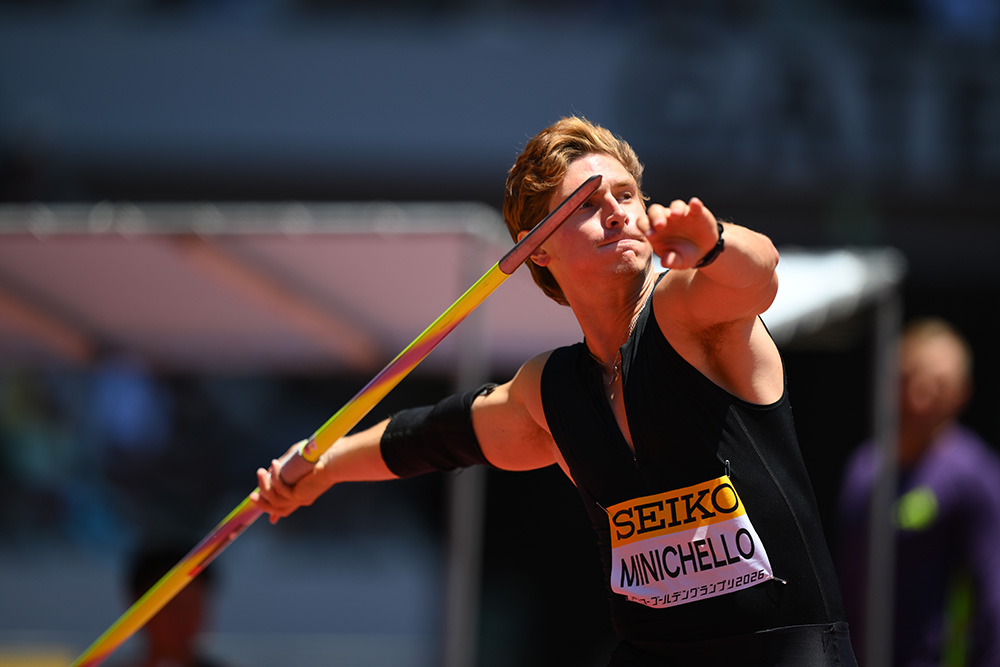
FOR A BASEBALL AND FOOTBALL player who just tried the javelin on a whim his sophomore year in high school, Marc Minichello has had an amazing career with the spear.
He was no better than 7th in any national championship competition as a prep at Wyoming Area HS in Exeter, Pennsylvania. But a monster frosh year at Penn in ’19, where he improved from 213-5 (’18 JavFest) to 253-0 (USATF U20 Champs), jump-started a progression during his undergrad and graduate years at Penn and then at Georgia. It eventually led him to NCAA titles in ’22 and ’24, and now has him on the precipice of ’27 World and ’28 Olympic medal contention.
At each stage of his decade-long career, the 25-year-old has overcome setbacks, has enthusiastically absorbed teachings from multiple mentors, and given himself new reasons to continue in the sport.
The current chapter has been a banger of a start to ’26, this odd, non-championship year that so many athletes are figuring out how to navigate. It includes a victory over WC bronze medalist and Team USA teammate Curtis Thompson at USATF’s Winter Long Throws Champs, then a sparkling new PR 275-11 (84.11) in a runner-up finish to Thompson at the Drake Relays that puts him in the top 7 Americans all-time.
In Tucson, unusual high winds and rain made for mediocre marks, but Minichello still relished the early-season, last-throw (247-1/75.32) victory.
“We left the competition not having distances that were reflective at all of where I was training at,” he says. “However, I learned that I was able to compete. I was definitely challenged by not having good throws in the early rounds, but still had an opportunity to put myself in contention to win with a good throw in the last and final round, which I did against a great competitor.
“It’s really great knowing that nothing’s ever gonna come easy [when competing] with Curtis. However, I have been fortunate enough to be able to beat him a couple times, and I know that if I keep to my path, we’ll be very competitive together.”
Four weeks later, Minichello came into Drake with confidence, belief in his training and coaching, and “not too many expectations other than knowing I’d been training well.” So the big PR wasn’t so much a revelation as it was “going out there and executing. It was nice to just be able to trust the plan, try to be smooth, and execute, and then let the distance kind of speak for itself. I just tried to be who I was and let the meet kind of take over, and that occurred, so I was happy to be able to come out and be the best that I’ve ever been.”
Extra focus on his runup that day paid dividends as well. “There was a strong headwind, so if you would just run how you normally would, you would get pushed back, and wouldn’t be able to maintain the speed that your mind thinks that it’s gonna be operating at,” he says. “So to combat that, you kind of have to put it into a little higher gear so that you can get back to that baseline that you normally work at in training.”
The big-picture reason for his current and hoped-for future success, says Minichello, is having better settled into the second year of a very competitive training environment at Georgia, where he continues to train with legendary throws coach Don Babbitt.
In his first year as a pro last year, following his collegiate career-capping title in ’24, the Dogs brought in Egyptian Olympian Moustafa Alsherif, who would throw 264-1(80.52) and take 4th at the NCAA. “It was my first season ever training with a true equal,” Minichello says. “We were throwing as far as we could… and would really push each other to levels that I’ve never seen in practice. It might have put even a little bit too much pressure on me in competition.”
Now after “another off-season of great preparation, understanding a lot about my throw, but not really trying to prove anything,” Minichello has found a comfort zone with a group that now also includes new transfer Jordan Davis, who threw 277-0 (84.45) in ’24 as a Southern Connecticut soph.
“Now I’m just trying to reflect on what I learned competing against the best people internationally last year and try to poach some of the techniques that I saw as translatable to me,” Minichello says. “And be able to slowly work them into my technique over time and to allow the technique to kind of do the work rather than using all this extra fire and intensity that I need to tap into in practice.”
The word “poach” is used with intent and care by Minichello, in the best possible way. Not only from his competitors and training partners, but learning from a long line of coaches that has led to Babbitt, his renowned UGA mentor who has coached AR holder Breaux Greer, among many others.
It started with his first throws coach at Wyoming High in ’16. “He wasn’t a thrower himself in the javelin, but he was just interested and wanted to be a sponge in the sport, learn about it and helped me learn about it. Then he eventually passed me along to Barry Krammes.”
Krammes is the co-founder of the Javelin Factory in Pennsylvania and hosts the American JavFest, originally launched by coach Jeff Gorski. Krammes has brought in countless great throwers and coaches to the annual event. “He’s one of the best, especially at that level.” Minichello says. “He really knows how to communicate and that’s what you need when you’re 16 years old and trying to learn the sport. You need someone who’s fun, but also has a great foundation of knowledge, and he was able to provide that.
“Then I go to Penn with Coach Jeff Pflaumbaum, worked with him, and he gets way more detailed… and took me to the next level. His background is so diverse, having studied religion and music in school, and then able to parlay that into a career in track & field and understanding biomechanics. He really comes with a unique perspective and just this depth of knowledge of so many different things. Ultimately, it centers around human performance and getting somebody to be able to execute something at a high level.”
During Covid, Minichello grew to love the sport even more and, on occasion, was able to work with former American Record-holder and outstanding coach Tom Pukstys. “He’s like a javelin super computer, and the way that he processes is absolutely incredible.”
Then, when Minichello had the opportunity to transfer for his final two years of eligibility, UGA, with its law school and Coach Babbitt, became the obvious choice.
“I’ve really been blessed with great, great coaching, and I’ve been able to take something away from everyone and see as a student in the sport where the parallels are and how the dots connect,” Minichello assesses. “Everybody is trying to speak the same language, and we all have the same goal of trying to throw the javelin as far as we can, but there’s a little bit different ways to say it and there’s different ways to get there.
“Understanding what I was being taught and how it could apply to me was critical in being able to develop the way that I have… And then the big ‘aha’ moment I’ve had this past season was actually a reflection on what I saw from international throwers last year.”
Last weekend Minichello found himself back in Tokyo, for the Continental Tour meet. To the comp in the Japanese capital, he came in riding high as a defending champion — he won there last spring for his first international triumph. He also came in with a chip on his shoulder. Last fall, finally earning his first Team USA trip as a senior-level athlete, he came up short in a bid to make the WC final.
This Sunday in Tokyo, while Minichello didn’t win, he placed 2nd to ’21 Olympic silver medalist Jakub Vadlejch. Minichello’s final-round 268-2 (81.74) bettered all throws in Vadlejch’s series save the Czech veteran’s 279-8 (85.24) round 2 effort, his longest since the Paris Olympics.
Minichello looks at the next three years as a “long game” with three steps. This year, he says, “is an opportunity for me to travel the world a bit and go compete against the best people; not just competing, but to try to go out and beat them. That is my goal for this season, to be able to be as competitive as I can, put my all on the track wherever I go, and go toe to toe with the best in the world, and sometimes beat them.
“I’m still young in the sport and there are going to be wins and losses, but I believe I can go out and have my best day when some people aren’t necessarily having theirs, and beat them.
This year, Minichello hopes, will set him up for success in ’27 and ’28.
“Knowing that there’s still levels to the sport, I don’t think that I’m necessarily ready today to go win 2027 Beijing, but I do think that there’s a good chance for me to be able to go there and make a final [and go beat a lot of people].
“And I think that’ll set me up really nicely for my large long-term goal, which is 2028, Los Angeles, home Olympics in the States, to be able to get up on the podium and medal in front of a home crowd. I think that is my goal, and it’s not gonna be easy, but it is certainly attainable with slow and steady steps.
“You know, you always hear the story of the tortoise and the hare, and it doesn’t seem like it makes sense. But the older you get, the more experience you have, the wiser you get, it’s the only thing that makes sense. Everything is going to happen over time with delayed gratification. So there’s no secret, there’s not going to be any one thing that’s going to fix my throw and allow me to become competitive at a medal level. However, if I just keep getting a little bit better day by day, learning and committing to the idea of growth, I think that my progression could possibly set me up really nicely.” □
