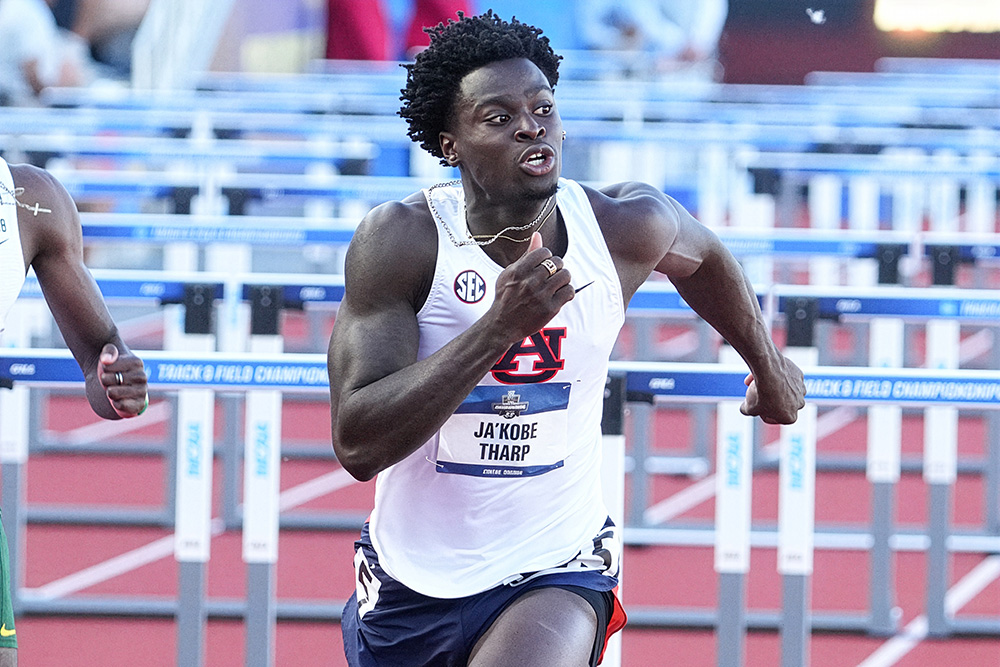
WITH APOLOGIES TO Charles Dickens, it was the best of times, it was the worst of times for hurdler Ja’Kobe Tharp, it was an age of transformation, it was a season of breakthroughs.
On June 10 in the NCAA semifinals, Tharp smashed the nearly 14-year-old WR in the 110H, clocking 12.75 to become the first sub-12.8 hurdler in history.
The Auburn junior went on to win the NCAA title in 12.90, that too a formidable clocking, then turned pro. He followed up with times of 12.91, 12.85 and 12.89 to set a new standard of sub-13 hurdling. Jamal Britt has also posted 5 sub-13s this summer, while Kendrick Smallwood (in the NCAA final) and Trey Cunningham have cracked the club for the first time this year and Bradley Franklin ran 13-flat.
Le’Ezra Brown has joined the conversation by setting a World Junior Record of 12.72 over 39-inch barriers and Zacchaeus Brocks set a High School Record of 12.98.
Keep in mind that injury-plagued world and Olympic champ Grant Holloway has not competed since last September, when he was 6th in his semi at the World Championships.
“This is probably the most competitive the hurdles have been in a while,” Tharp says. “When Grant was on his tear, he was the one man. That was it. Now we have all these other guys that are running these super crazy fast times and you’ve got to be the best on the day.”
That day was not August 21 at the Lausanne Diamond League, when Tharp saw another time he never expected in his wildest dreams. If 12 seconds had been a goal, 14 seconds was supposed to be strictly in his rear-view mirror.
Just 0.01 behind Britt at the sixth hurdle, Tharp clobbered the barrier, losing his rhythm. He coasted in last in 14.38 — the same time he ran as a 10th grader in ’21 when he placed 3rd in the Tennessee state meet (39-inch hurdles).
In response, Tharp posted on Instagram a string of laughing/crying emojis. He rebounded two days later in the Chorzów DL, coming strong off the ninth hurdle to edge Cunningham 13.05–13.08. Britt was 3rd in 13.09 with world champ Cordell Tinch 4th in 13.22.
“If I can come out here and beat a loaded field each and every weekend, I’ll be in a good spot,” Tharp said after the race. “Last week wasn’t my best, but bad races happen and we move on.”
He added that coach Ken Harnden, who was recently promoted to head coach at Auburn, would not be happy with his technique over every hurdle in the race, but Tharp couldn’t complain after notching another DL win.
“One thing Coach Ken likes to say is, ‘We don’t have to be perfect.’ We don’t really chase perfection. We chase consistency,” Tharp says.
Harnden and Tharp never talk about times.
“We talk about executing races and trying to win races,” Harnden says. “Whatever the clock says, I don’t care if you win the Olympic Games and it says 13.3, you’re the Olympic champ for the rest of your life, and that’s all we worry about.”
But sometimes the 20-year-old can’t help letting his desire for speed take his mind off his execution.
Tharp’s first lost of the season came at the Prefontaine Classic — which was also his first meet as a pro. In that, the new WR man’s first competitive outing since the game-changing NCAA, Britt ran a 12.86 PR to Tharp’s 12.91.
“He got to hurdle 5 and decided he was going to break the World Record again instead of executing the last 5,” Harnden says.
Tharp wound up pressing hard, just as he did in the NCAA final — although that earlier race at least resulted in a victory and a title. “You cannot think about a time,” he says. “If you think about a time, it won’t happen.”
At Pre, Tharp was out ahead of the field at hurdle 4. At that point in college the race was usually over, Tharp says, “because nobody can close how I can close. I decided, ‘OK, I’m already in the lead, let me go ahead and win and blow everybody out of the water.’ But it’s not a thing anymore. My coach had to pull me aside and tell me, ‘These guys aren’t these collegiate hurdlers where if you decide you want to go and pull away from them, you can.’
“I had to realize that I should just focus on what I’m doing.”
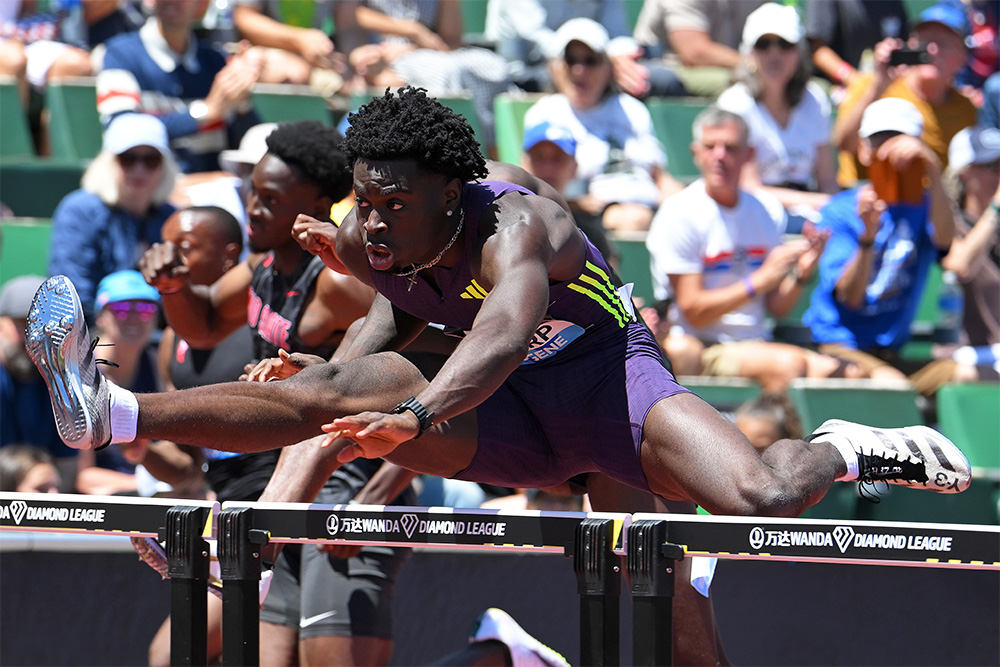
Tharp was back on top in Budapest and London against star-studded fields, where he was the only hurdler to dip under 13.
“The competition level is rising,” he says. “It’s not just one big standout guy. Guys are performing each and every weekend. I’m a big competitor, so that just pulls out the most in me to know that these guys are pretty quick, too.”
Harnden shouldered the blame for Tharp’s aberrant performance in Lausanne, saying, “I didn’t prepare him well for the first race.”
Tharp’s 4-week campaign in Europe continues with Bellinzona, Switzerland, followed by the DL Final in Brussels and the Ultimate Championship in Budapest in September.
The UC will be his first global stage as a senior athlete after winning World U20 gold in Lima, Peru, 2 years ago. He said a win will give him even more confidence going into Worlds next year in Beijing and the LA28 Olympics.
“If I go out there and put my best foot forward, there’s nobody on this planet that can run with me,” Tharp says. “If I’m on my A-game, for sure.”
Harnden, an Olympian for Zimbabwe in the 400H, competed in the ’90s, which marked the previous golden age of the 110H.
He recalls when Allen Johnson, Mark Crear and Florian Schwarthoff swept the Olympic medals in ’96, with Mark Crear 4th.
“It was incredible and there was never a down competition,” Harnden says. “You never went to a meet where only one of them ran. There were always two or three or four. I don’t think the depth has been there between the mid-90s, late 90s and now.”
With that depth back, he says, “that’s what makes it so much fun to watch. On the men’s side, I don’t know that there’s a better event out there at the moment.”
Harnden’s theory on the burgeoning 110H talent pool relates to football. “Philosophically, I would tell you that 20 years ago concussions in football became a real thing in America and I think there’s some athletes that are not playing football that are running track.”
However, he also sees great coaching and athletes emerging around the world, such as Shunsuke Izumiya of Japan and Kendry Menéndez of Cuba.
“We’ve always seen this: when somebody raises the bar, everybody else realizes that it’s possible,” Harnden says.
Tharp says Holloway set the pace the last few years, including his 6 sub-13s in the ’24 Olympic season.
“That’s a big goal people want to hit,” Tharp says. “He did that 6 times so that really made it, ‘OK, if he can do this 6 times, then why can’t I go out there and do this however many times?’”
He states matter-of-factly that he’s had a target on his back since winning the SEC title as an Auburn frosh in ’24. He had a PR that year of 13.18, which he lowered to 13.01 in ’25 while winning his first U.S. title against the likes of Tinch, Dylan Beard and Cunningham.
“I’ve always had to train a little bit harder because I know guys are coming for me,” Tharp says.
And he’s happy to do it.
“He relishes it,” Harnden says. “Since Allen Johnson, I’ve never met somebody that wants to win as bad as Ja’Kobe that I’ve been around, other than myself. I just didn’t have the ability to do it on the level that they did. He is motivated by winning, but he is also motivated by the mistakes and the losses.”
When Tharp signed with adidas, he insisted that he stay in Auburn to train with Harnden. He is taking online classes and is on pace to graduate in 3½ years with a degree in interdisciplinary studies (Business & Sports Management).
Because of the long seasons the past three years with Junior Worlds, Worlds and now the Ultimate Championship, Harnden has moved training back by almost 4 weeks to compensate.
The coach also indulges — and even delivers — Tharp’s premeet ritual: a McDonald’s two-cheeseburger meal, large fries, 6-piece nuggets with sweet & sour sauce and water. Tharp eats it 3 hours before the start of his event.
As he says time and again, it’s all about consistency.
“There’s not that much more I can really fix,” Tharp says. “It’s the tiny details that make the huge changes in my time whenever the real races come — just putting my foot down, getting to the hurdle on my takeoff and pushing my trail leg on the back side.”
Brown, who broke Tharp’s AJR of 13.05, says his former SEC rival is an inspiration. While Tharp and the Georgia Bulldog share an apostrophe in their names, their approach is different.
“Ja’Kobe doesn’t talk trash. Le’Ezra talks trash,” Harnden says. “And I think Ja’Kobe loves that, but he’s a ‘I will show you, I don’t have to tell you.’”
Tharp agrees. “We all get along outside the track, but come race day, there’s no more friends,” he says. “It’s time to get serious for sure. I don’t do much talking. I’ll let whoever wants to talk talk, and I’m going to go out there on race day and handle my business. We can talk after the finish line.”
And if the clock is flashing an amazing time, all the better.
“Everybody wants to see the next crazy thing,” Tharp says, “but those things happen when they happen. You can’t rush them.”
