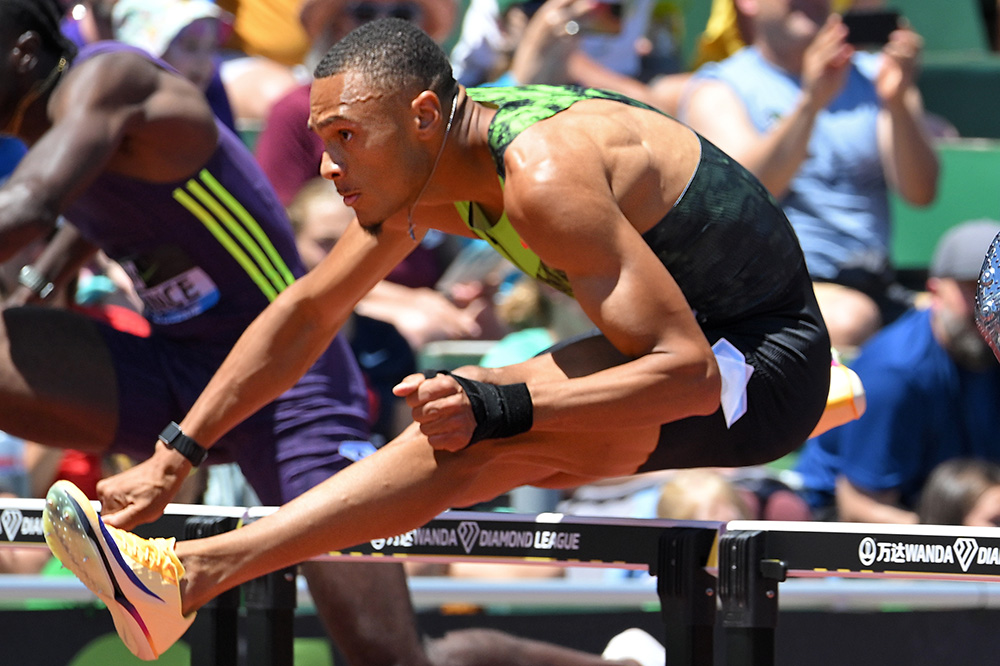
EVERY TIME THIS SPORT knocks Jamal Britt down, he shows up again, even better. The arc of his career embodies one consistent theme: he keeps going when other men might have quit.
That persistence is finally paying off. After toiling for years as an unsponsored athlete, he signed a Nike contract after hurdling to a breakthrough 12.89 to win at the Paris DL. Another significance to that time: he bettered his coach’s PR finally, the 12.92 that Allen Johnson ran when he won the ’96 Olympic gold medal.
Britt flew even faster at the Prefontaine Classic, a 12.86 for the win. So far this season he has 5 performances under 13 seconds, but he says it was the first that he is proudest of. After equaling his PR of 13.07 a remarkable 4 times, he came to Rome looking, of course, for the barrier-breaker.
Battling for the lead with Trey Cunningham at the Golden Gala, Britt appeared poised for success when he clipped hurdle 9 and crashed on 10. Cunningham got his first career sub-13; Britt got a broken hand.
“Flying back home, I was like, ‘Dang, it was right there.’” He returned to Greensboro, where he trains with Johnson, the head coach at North Carolina A&T. “For 5 days I was just focusing on racing again and trying to crack that barrier.”
The next race, 10 days after the fall, was the LA Grand Prix. This time Britt raced alongside Cunningham and edged him with a strong late-race drive. Eyes on the clock, he jumped up and down and shouted when 12.99 popped up.
“Once I cracked that barrier, it was more of a relief,” he says. “It’s like, ‘OK, even in a situation like that, I can still go out there and get back up and do what I can do.’”
Such is the thread that runs through his career. Back in North Las Vegas at Legacy High, he won a few state titles but was no national superstar. His best was just 14.20. He showed more promise in the long hurdles at 36.51, but the big scholarships went elsewhere. He chose to run at the JC level, at California’s College Of The Sequoias.
As a soph he won California JC titles in the highs, 400H and long jump. That earned him a spot with the Iowa Hawkeyes. “It was great,” Britt says of his time there. The school was loaded with hurdlers, and yet, he says, “That school was truly serious about me; they were wanting me to wear the uniform and actually represent them.”
His first full year in the uniform came in ’21, and more and more, he found himself focused on the highs. Indoors, he placed 2nd in the NCAA. Outdoors he ran 2nd in the Big 10, 4th in the NCAA, and his breakthrough came with a 13.27 in the heats at the Olympic Trials, where he finished 7th in the final.
He turned pro in ’22 — without a contract — and produced a solid season, running a PR 13.09 for 4th at USATF and then taking NACAC silver with his PR 13.08.But progress failed to come the next year, with a best of 13.14 and a 6th at USATF.
The focus was on ’24 and the quest to make the Olympic team. His early season seemed lackluster but he came to Eugene sharp, hitting a PR 13.07 in the first round. A rough 13.32 in the semis meant that he wasn’t going to make the finals this time.
The financial picture wasn’t pretty, a story that’s not uncommon among those who miss the team. “I was like, ‘Well, this is rock bottom for me.’ And even in my mind, I’m just like, ‘Should I even still continue?’ Because I went from being able to scrape by to not even able to pay something as simple as my rent or electric bill. And sometimes I even struggled to feed myself.”
Last year, he started working with Johnson, a connection made possible by his girlfriend, ’21 hurdle Olympian Gabby Cunningham, who worked with Johnson at NC State. Almost overnight, Britt became much more consistent at a fast level. However, at the USATF Champs, disaster struck. After a promising 13.12 semi, Britt drew lane 5 in the final. In the thick of a 4-way battle for team spots to Tokyo, he hit hurdle 6 and went down at 7.
He remembers for an hour or so afterward he was down. “Then I was just, you know what, I just got to move on. I have more season to run, you know, and I just got to do what I got to do. It happens.” He finished out the season with a 3rd at the Diamond League Final in Zürich.
Making it that far as an unsponsored athlete presented all kinds of challenges. “I had a lot of obstacles, trying to maintain, paying for everything, in terms of not just needs like rent, food, gas, or whatever just to get around, and also [physical therapy] treatment. And that was a struggle for me because I would make a little bit of money and stuff like that while working a job. But it was also difficult because treatment is also very expensive.”
He also notes that his career path took him “from Iowa to Arkansas to Greensboro, and the rent was getting higher and higher.”
The money grind affected the way he looked at his craft. “I was more focused on money than on my performance, which should have been the other way around for me. Because if you perform, the money will come.”
A few developments before the Nike contract even happened helped Britt weather the financial grind. He credits the grant that he first got from the USATF Foundation in ’24. “That helped me push by a little bit, and push by a little bit more going into ’25. It continued to help me a lot this season.”
Another boost came from Britt’s official recognition as a member of the Cherokee Nation, a heritage he got through his father’s bloodline. “They were able to get me health insurance and stuff like that. That was something I needed to pay for [PT] and just to keep myself going. They’ve been doing me great.”
Finally, one of the bright spots of his ’25 season was that he was the champion for the now-defunct Grand Slam series. He eventually got his prize money after he had returned to a job at FedEx. “I ended up finding out the news that the athletes were getting paid while I was literally at work. That helped me a lot more because I was able to back off of work just a little bit. I was working on trucks, lifting a lot of heavy boxes, which can cause me to get hurt and stuff.”
All of those developments helped set up the 27-year-old for his dazzling current season. “Coach Johnson and I have been working on just executing my race plan,” says Britt of the ’26 goal. “Last year, I proved that I can consistently run 13.1 all the time and maybe 13.0 on a very good day. And this season, the goal was to run faster than that… Coach decided, ‘Why not just run all these races and get the rhythm down?’”
He adds, “On the U.S. Rankings, I was pretty much on the bottom against the other guys. So I really was just trying to prove myself this year and set myself up for the next two years. Because the World Championships and the Olympics are the big ones.
“After falling at USAs last year, thinking that was my last attempt of even trying to make some money, I just continued to stay on the course and focus on my craft. And once the season started, really, I just wanted to prove myself right and make a name for myself. To show everybody that I’m also a guy that can compete for these medals.”
The biggest lesson he has learned from working with Johnson, himself a 4-time World champion and Olympic gold medalist, is a fairly simple one. “All it is, is go out there and compete. At the end of the day, it’s me against me. And, you know, back in his day, all he cared about was winning. So I always try to have that same mindset, because all you want to do is win. No one wants to go out there and just lose.
“I picked the right event for me at the end of the day because this event is growing a lot, and it’s actually going to be at its best, and probably maybe the best that we’ve ever seen. Even still, I think I’m an underdog at the end of the day, and I have no problem with that because I’ve always been an underdog in my life, and I’m never scared of a challenge.”