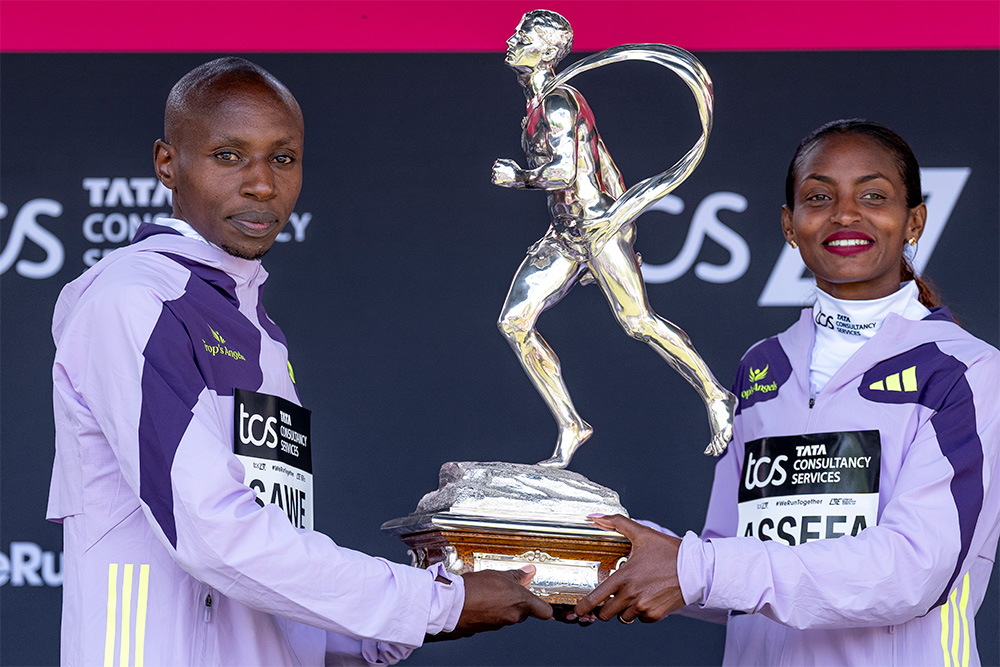
NOT SINCE USAIN BOLT was breaking 100 WRs almost two decades ago has a performance from the sport garnered as many headlines and as much attention in the wider world as Sabastian Sawe’s sub-2 performance in the London Marathon.
However, while the path Bolt trod to reach his summit was extensively chronicled, many athletics aficionados were still asking, “Who is Sebastian Sawe?” after his landmark feat of road running on April 26.
His ’23 World Half-Marathon title and thre3 big city marathon wins prior to Sunday are a matter of public record but, at the age of 31, Sawe has only been racing internationally for 4 years.
Unlike so many of his compatriots who make the big time, Sawe didn’t show prodigious promise as a Junior on the track. Nor did he — as has become increasingly the case — jump straight into road running in his late teens or early 20s.
In his teenage years, and despite a tough rural upbringing which saw him being mainly brought up by his grandmother, he was lucky enough to attend the famed St. Patrick’s HS in Iten, the nursery for so much Kenyan running talent.
It was here that he had some modest success in provincial races, mainly as a middle-distance runner, but there was nothing that especially marked him out as a someone who would one day make history.
Contemporaries have remembered Sawe as being serious but, with both modest academic and athletic talent, for several years after leaving St. Patrick’s, Sawe worked on the family farm.
However, he still harbored the dream of becoming a professional runner, for many a way out of the grinding rural poverty that persists in western Kenya where the GDP per capita income is almost more than a third lower than the national average.
Fortunately, an uncle in his extended family, Abraham Chepkirwok — a St. Patrick’s pupil a decade earlier who, representing neighboring Uganda, had finished 4th in the ’07 WC 800 — agreed to use his connections and money to support Sawe’s ambitions.
For two years, it looked like a pipe dream but in ’19, having arrived late for a meet in Kakamega he found that the 5000 was the only race remaining on the program but won it in 13:56, which earned him some modest recognition.
However, the breakthrough to fame and riches via international races still eluded Sawe and late in ’20 he changed training groups to work with the noted Italian coach Claudio Berardelli.
“I was so happy; it felt good from the start, like now would be my time,” recalls Sawe, who slowly started to prosper in the new environment.
Finally, Sawe made his first international trip to the Seville Half-Marathon.
Employed as a pacemaker, and racing under his middle name of Kimaru, he went through the first 10K in 28:10. Instead of dropping out, though, he followed through when the race organizer motioned him to finish. He crossed the line in a course record 59:02, the second-fastest half seen in Spain at the time.
“This opens up a world of possibilities, an entry into the international elite,” commented one local newspaper presciently at the time.
Further victories under an hour in the Rome–Ostia and Manama Half-Marathons confirmed his Seville win was no fluke. So did his 6th-place finish in the Valencia Half — where he was first to make the acquaintance of Ethiopia’s Yomif Kejelcha, who finished 2nd there in a 58:32 NR. Kejelcha would eventually battle valiantly with Sawe in the barrier-breaking London race — and make himself history’s second sub-2 marathoner just 11 seconds after the winner.
’23 saw Sawe win 6 of his 7 outings in world-class road events including the World Half title in Riga, Latvia, as well as his triumph in the brutally competitive Kenyan XC Champs.
His move to the marathon has now become history although it is a mark of regret that Sawe and his predecessor as WR-holder Kelvin Kiptum never got to stand on the start line of a 26-miler together, the latter tragically killed in a car crash in February ’24.
In fact, sadly, Kiptum never got to see Sawe in a marathon as he made his debut in December ’24, winning in that year’s world-leading time of 2:02:05.
Nevertheless, Kiptum’s influence was gently felt on Sawe’s career and his historic 1:59:30 time in London.
“He [Sawe] and Kiptum never trained together but they knew each other a little bit and certainly talked about the marathon, how to race it, Kiptum’s success and what Sawe needed to do to make the transition,” Sawe’s manager Eric Lilot confirmed in London after the race.
It looks like Kiptum imparted some good advice. □
