OFFICIAL SPLIT DATA reported for major meet 4x4s often lead to confusion — and on more than one past occasion obvious errors. Sometimes these are never corrected.
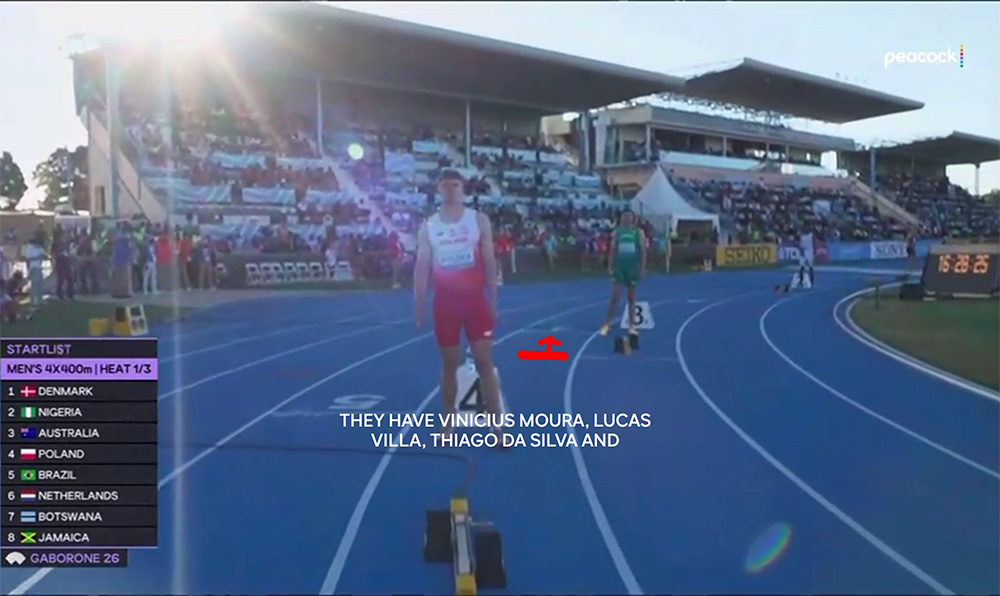
Thus it was not an unfamiliar state of affairs when some of the 4×4 heat splits reported by Seiko at the World Relays elicited head-scratching. Keen observers in the most noticed instance didn’t buy that in heat 1 of the men’s long relay the Australia men’s team’s third leg, Matthew Hunt, a 19-year-old with a 46.27 open 400 best, had turned his lap in 42.60. That left second leg Reece Holder with a pedestrian-for -him 46.34 carry.
As this is written three days later, Seiko’s revised results report still lists those spurious splits yet those watching would tell you Holder, not Hunt, had been the one to lay down a burner. A 23-year-old veteran of the Paris Olympics, Holder’s open best is 44.53. In the final here he split 43.1, a figure nobody is questioning.
Karl Steinhoff, a veteran track nut with a head and eye for numbers, rewatched the race, studied the Seiko results and decided the Holder and Hunt splits in heat 1 had to be more like 43.11 and 45.83.
Let’s let Steinhoff tell it. “The problem with this data was that the times reported by Seiko for 400 and 800 appear to be correct, but randomly assigned somehow to the wrong teams.
“This was based on a rewatch of the order of the passes and seeing the various gaps between teams — the reported times look to be consistent with what happened once we reassign them to the teams based on the actual order in which the teams came into the zone.”
Specifically, Steinhoff identifies the following apparent errors in the Seiko data.
“In the case of Australia, for instance, the ‘official’ split shows 1:30.85 for 800 and 2:13.45 for 1200 — doing the math, that’s 42.60.
“The thing is, that 1:30.85 is the time for Nigeria, who handed off in 6th place. So that sub-43 came by subtracting intermediate times from two different teams — it’s a meaningless number. The 2:13.45 was indeed the Aussies, but the 1:30.85 was not.
“Australia came through two laps in 1:27.62, but that time was somehow credited to Brazil, which actually came through in 1:30.34.
“So if we go from 1:27.62 to 2:13.45, that’s 45.83, which is the correct time.
“In other words, I didn’t retime everyone, I just looked at the existing times to see if they made sense once applied to the proper teams. And they do.”
The first-day 4×4 gaffes in Gaborone didn’t end there, though. Australia ran in lane 3 for its heat. Lane 3 splits for the 4x4s looked a tad dodgy across the board. Social media buzz followed.
Then somebody noticed that overnight from day 1 to day 2, the lane 3 start line was moved! (x.com poster @iownabook seems to have been the first to spot it.) A guesstimate from video images suggests the new stripe was repainted about 2m farther back along the oval.
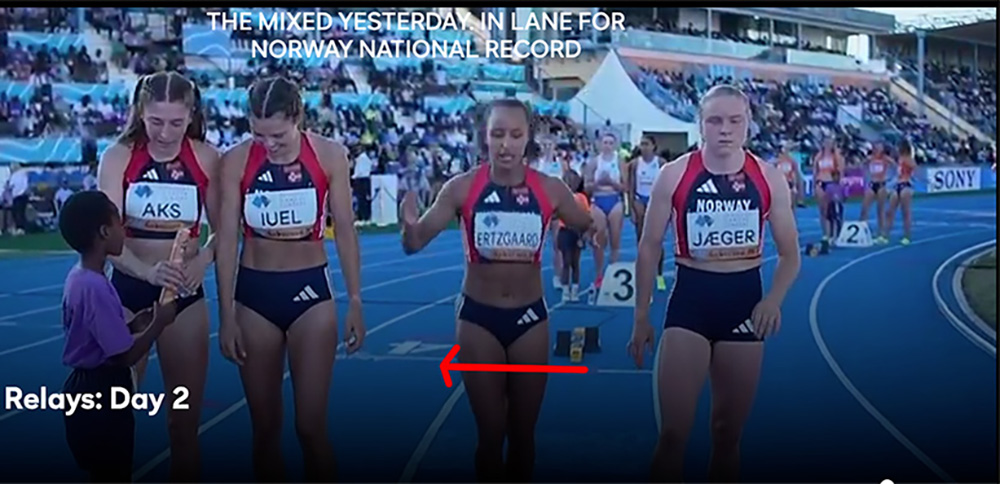
Some track surveyor had one job… You know the saying. What happened? So far World Athletics has issued no comment.
Bottom line: While the final finish orders in all the 4×4 heats — women’s, men’s, mixed — are correct, there’s a problem with the times. Every team that drew lane 3 relayed approximately 1598m, not 1600. Hardly a level playing field.
We’d share Steinhoff’s corrected split numbers. However, there’s one more problem with the data.
T&FN has learned that none of the leadoff-leg splits were derived from photo- or video evidence, or chip times — which are sometimes used in major meets.
Instead, Seiko estimated them using the “Sparks Tables.” The late Briton Bob Sparks was an assiduously dedicated lion of the stats world one of whose projects was to invent a method for ballpark-estimating 4×4 first-leg splits in the absence of enough officials to capture the times with stopwatches.
The 4×4, of course, is run with a 3-turn stagger. Teams stay in lanes until the second runner exits the first turn after the initial exchange. Thus, leadoff splits are taken at the midpoint of each lane’s exchange zone. For lane 1 that’s at the finish line. All the other zone midpoints are farther down the track. Yes, this is 4×4 Rules 101, even if many fans have not given it much thought.
The Sparks Tables enumerated expected time differentials between the instant a baton would pass the lane 1 start-finish line and reach the midpoint of each exchange zone in lanes 2–8.
Based on historical data, the tables make possible reasonably good leadoff split guesstimates. But there’s no reasonable cause to assume they give rise to splits to the hundredth the sport should “take to the bank” as fact.
At least one commercial timing company, but not Seiko to the best of T&FN’s knowledge, uses a separate 60-frames-per-second video camera linked to the timing system and trained on the exchange zone midpoints to capture splits accurate to within 0.01–0.02 of what a regulation finish camera would record.
Those, you can damn near take to the bank. When Seiko employs the Sparks tables, it should report the splits to the 10th, not the 100th, and tag them as “estimated.” Bob Sparks would agree.
Doesn’t a World Athletics fixture with a name like World Relays deserve at least that level of care?

