AN OLYMPIC GOLD MEDAL says you were the best on one particular day. A World Record says no one has done it faster on any day.
Masai Russell now owns both distinctions.
Just 37 minutes after Alison dos Santos broke the men’s 400H record, Russell crossed the line in 12.09 to take the women’s 100H into territory it had never legally entered.
The symmetry went beyond two hurdle records falling on the same Zürich night. In both races, the outgoing WR holder watched his/her reign end while finishing 2nd behind the athlete who ended it. Karsten Warholm followed dos Santos home in the 400H. Tobi Amusan did the same behind Russell in the 100H.
Possibly this is the first time on the same date that two WR holders have finished as runners-up in the races in which their records were broken. We’d wager a raclette dinner that it’s the first time it has happened 37 minutes apart.
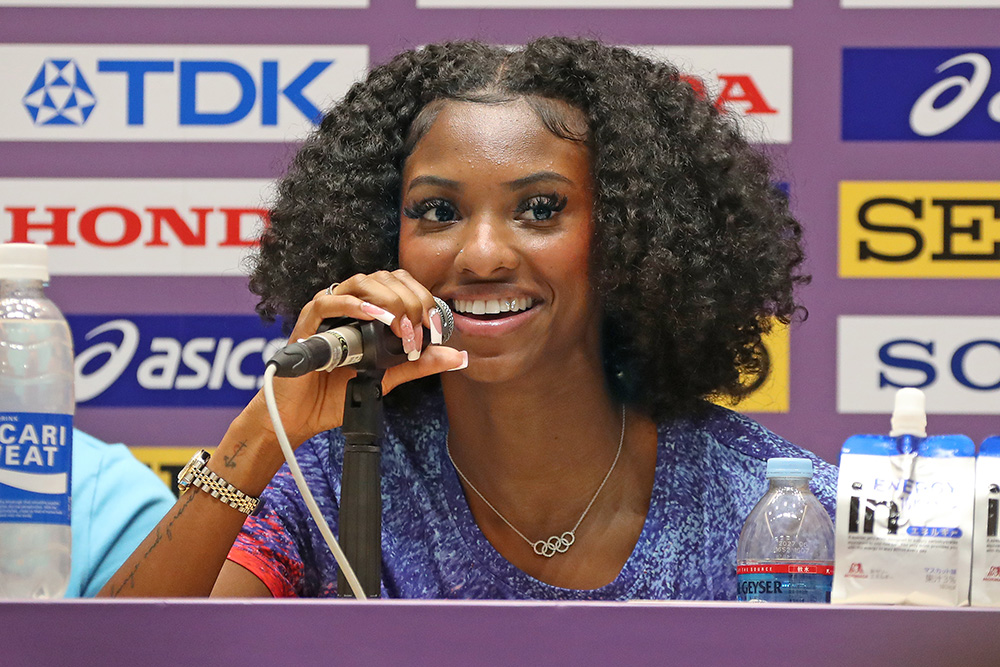
“I’m still processing it,” Russell says. “It’s a blessing just because I’ve been chasing it, and the world’s been talking about it. So just to finally do it, it’s like, all right, I can breathe a little bit. Not all the way, but partially.”
She had been telling anyone who would listen that the record was coming.
After winning the ’24 Olympic Trials in 12.25, then No. 5 on the all-time list, Russell said, “I believe that I can respectfully touch the World Record. I don’t know when, I don’t know where.”
After winning in Chorzów last year: “I’ve been saying all year that I’m gonna break the World Record.”
And after capturing her third U.S. title weeks later: “I’m becoming who I believe that I am. Hurdle queen, period.”
In Zürich, Russell made good on all of it.
She won the Olympic title in Paris 2 years ago, leaning across the line in 12.33 to beat Cyrena Samba-Mayela by 0.01. Yet the gold medal did not make Russell the year’s dominant hurdler.
She World Ranked No. 3 for ’24. Jasmine Camacho-Quinn won 5 of her 6 DL appearances and beat Russell 7–1 head-to-head, while Ackera Nugent produced 4 of the year’s 5 fastest performances.
Russell had won the year’s most important race, but not put together its best overall season.
That distinction remained relevant in ’25. Russell broke Keni Harrison’s American Record with a 12.17 in Miramar, won the U.S. title and added a 12.19 victory in Chorzów. But a collision with hurdle 5 left her 4th at the World Championships. She World Ranked No. 4.
“I kind of struggled with some doubt coming from being the Olympic champion and trying to prove to everybody else who I was, rather than just operating in the realm of who I know that I am,” she said before this season.
The ’26 version of Russell has looked increasingly certain of both who she is and what she can do.
Before Zürich, she had broken 12.30 in every outdoor final: 12.25 in Shanghai, 12.14 in Xiamen, 12.26 in Los Angeles, 12.24 at the Pre Classic and 12.27 in Lausanne.
Five finals, five performances beyond a barrier most hurdlers never approach.
In an event where one clipped hurdle can mean the difference between 1st and last, that repeatability offered its own evidence that something historic was building.
Russell’s 12.14 in Xiamen moved her within 0.02 of Amusan’s record and lowered her own pending American standard. In Zürich, she lowered it again by another 0.05.
The progression echoed Harrison’s ’16 campaign. Harrison ran an American Record 12.24 at the Pre Classic, then lowered it to a World Record 12.20 in London less than 2 months later.
Amusan was the first woman under 12.20. Russell is the first into the 12.0s.
That she did it with Amusan in the race seemed appropriate. The best women’s hurdlers may be world class at dodging up and down over hurdles, but they’re certainly not known to dodge one other.
Russell had been meeting Amusan and the rest of the sport’s deepest field throughout the season rather than choosing isolated opportunities to chase the clock. In Zürich, she again faced Amusan, ’25 No. 1 Ranker Ditaji Kambundji, Nadine Visser and a field filled with familiar faces.
“The field — I had Tobi, I had just some great people in the race,” Russell says. “It was set up perfectly.”
So were the conditions. Russell had expected late-August Switzerland to be chilly. Instead, she found temperatures in the 80s, a fast track and a “lit” crowd already energized by the performances that had preceded hers.
“When I heard the crowd, I was like, ‘Oh, it’s gonna be a good day,’” she says. “Then I heard Alison broke the record. I was like, ‘So what’s it gonna give today?’”
Racing out of lane 5, Russell shot from the blocks and cleared every barrier with Swiss-watch precision. Sensing that the victory was hers, she reminded herself, “Let me actually run through the line this time and see what the time looks like.”
“When I looked over and I seen 12.09, I was like, ‘Oh, shoot. I just did it.’”
Amusan finished 2nd in a season-best 12.23.
The scoreboard flashed 12.09, and every track fan knew immediately to look for the other number, the one that would determine whether history counted.
They saw nothing.
The wind gauge read 0.0. Perfectly still. No assisting breeze, no asterisk, only the first legal foray into the 12.0s in event history.
Russell raised one arm as she crossed the line, then continued halfway around the turn before stopping to face the cameras. She placed a finger to her lips.
The gesture seemed less like a victory proclamation than a request: let’s be quiet, just long enough to let the moment register.
Inwardly, Russell says, it was anything but quiet: “When I settled down and no one was really paying attention, I was like, ‘Oh my gosh, I’m really doing everything that I said that I would.’ No one sees what it takes for these moments. They just see the outcome.”
She also remembered those who had decided that 12.14 represented her ceiling.
“People were like, ‘Masai’s PB by the end of her career is gonna be 12.14.’ So I bookmarked that. I can’t wait to quote-tweet that,” she said. “Every time y’all doubt me, I just show y’all that I’m not like anybody else.”
Now that 12.09 has settled one question, Russell is willing to raise another. With a legal wind closer to the allowable limit, she believes Zürich might already have produced the first sub-12 performance.
“I think if we get a 1.9 wind behind my back, that could have been a sub-12 race,” she says. “Everything that I’ve said that I wanted to do has come into fruition. So why not say, ‘I think I could be the first one to run sub-12’?”
When might that happen?
“Who knows?” she feels. “You can’t plan it.”
Nor will she put a number on what she ultimately believes she can run: “When we put times on ourselves, we limit ourselves. Honestly, I don’t know what is possible at this point.”
For the moment, the answer is 12.09 — the fastest any woman has ever legally covered a flight of 10 hurdles.
Russell can breathe now. Just not all the way.