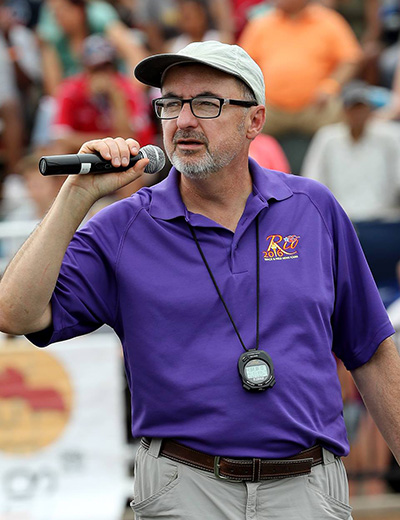
FOR ME, THIS YEAR of the high hurdles kicked off locally. I announce some nearby track meets, and I got the pleasure of being at the mic when Michigan prep Zacchaeus Brocks started his outdoor season. With flawless form and stunning speed I hadn’t seen before in a high school hurdler, Brocks charged through his races in May, usually winning by huge margins.
“How fast could he go?” I wondered. Surely not as fast as the national prep record of 13.08. But in talking to him, I found out that was indeed in his sights — the young man proved exceptionally prophetic.
The drama and excitement we experienced in Michigan was just part of what I would call a historical transformation of the event nationwide — with worldwide implications. In Alabama, Auburn’s Ja’Kobe Tharp, after winning the NCAA Indoor 60H in a Collegiate Record 7.32, was readying to take that speed over the full 110m.
Focus On High Hurdlers
Later in this issue don’t miss our profiles of four standouts among the current stampede of breakout 110H talent.
Training in North Carolina, Jamal Britt equaled his PR of 13.07 three times in the early season and appeared ready to fly to another level. Meanwhile in Texas, Kendrick Smallwood brought his best down to 13.04 on his way to bigger things.
Based at Alabama’s Samford University, Bradley Franklin hurdled a windy 13.07. And at Georgia, frosh Le’Ezra Brown put himself atop the U20 rankings with his 13.22.
All exceptional prospects, but little did we fans dream that those were just the opening salvoes in a summer of hurdling fireworks!
It started in early June, when Trey Cunningham, after knocking on the sub-13 door for years, finally broke through with his 12.98 win in Rome.
In the heats at the NCAA we saw Tharp shock the world with his 12.75 World Record. Then in the finals, Smallwood followed him under 13-flat as they went 12.90 and 12.95.
Brocks won his USATF U20 matchup with Brown as both ran 12.98 over the 39-inchers, Brocks becoming the first prep under 13 and Brown running 12.95 in the heats. (Sadly, from my stat fan standpoint, we never got to see Brocks race the 42-inch barriers. It’s the only height he trains over, and he was likely much faster than the HSR of 13.74, a mark he reportedly bettered in training.)
Britt just kept getting faster, breaking 13 three times in June before his stunning 12.86 on the Fourth of July to win the Prefontaine Classic.
World champion Cordell Tinch won the USATF crown but just barely, as upstart Franklin matched his winning 13.00 in confounding the formcharts.
At the World Juniors Brown got his day in the sun, tying the WJR with his 12.72, as Brocks, bound for Ohio State, joined him on the podium with a bronze and another 12.98 HSR.
So who’s going to make the team for the ’27 Worlds and the ’28 Olympics? All we can say from this vantage is predict the team at your own peril.
Don’t forget, we still have the legendary Grant Holloway in our midst. And Tinch’s credentials cannot be denied. Britt is hungry and improving fast. Cunningham will always be a contender.
Any prognosticator would be foolish to discount the young talent coming up. Not just Brocks and Brown, Franklin and Smallwood, but consider ’26 preps Rylan Hainje (13.16), now at Marian University in the NAIA; Andrew Jones (13.14/12.97w), at Texas A&M; and Joshua-Kai Smith (13.06), who is at Florida.
The NCAA ranks also keep churning out the talent: Ohio State’s Braxton Brann clocked 13.07 in that NCAA final. Ja’Shaun Lloyd of Texas State hit 13.22 this season and went 13.01 over the U20 barriers. Houston’s Jamar Marshall went 13.04 before placing 4th at the USATF meet.
A dozen men worldwide broke 13.10 this season, 8 of them American. The 4 who broke 13? All U.S. athletes.
Not since 1960 has the United States swept an Olympic or World podium in the event, but maybe it’s time for us to start dreaming again.
After all, for us hurdle fans, these are the good old days.