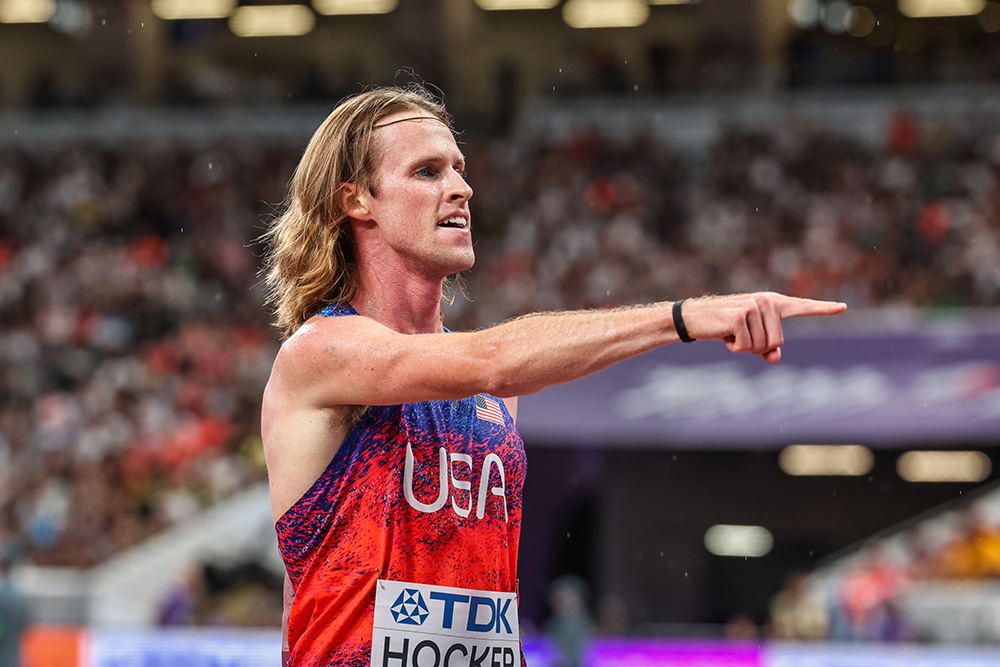
THE FOLKS IN INDIANA knew about Cole Hocker before he went to Oregon in ’19, but to much of the track world, it was a shock when the then-19-year-old ran a 3:50.55 behind teammate Cooper Teare at the start of the ’21 season and went on to win the Olympic Trials and place 6th in the Olympic 1500 final.
Hocker turned pro after that first outdoor season as a Duck, and since then has become one of the most formidable 1500 racers on the planet. He captured the gold in Paris with an Olympic Record, the fastest American time ever. A year later, stymied by a disqualification in the semis at the Worlds in Tokyo, he responded with a stunning win in the 5000.
We caught up with him for a conversation in the days before the Prefontaine Classic and talked about the racing life, tactics, and pressure as well as his beginnings in the world of music production. Surely you wonder, is he better at music than Mondo? “I don’t know,” he says modestly. “He’s got the pipes. I don’t really sing, I just produce. He might have it a little bit more figured out than me right now, but I’m more grassroots. (Continued below)
T&FN: How are you doing these days?
Hocker: Doing good. It’s been a solid last few months and I’m out here in Eugene getting ready for Pre.
T&FN: I understand you’re splitting time between Blacksburg and Portland these days.
Hocker: Yeah. I’m still working with Ben [Thomas] very closely and it’s nice. I have my girlfriend out in Portland with me and there’s great training out there. The Nike campus is great for training and anytime I’m back in Blacksburg, Ben’s got the keys to the kingdom there.
T&FN: I heard you had an injury some months ago.
Hocker: Pretty much through the entire indoor season, I had a pain in my lower stomach area. I was trying to get it diagnosed. It took a little bit. Ended up just being a pretty inflamed pubic symphysis joint. It was painful through the races, through World Indoors.
It was one of those injuries that you can time when you want to address it and so I said “I’ll take care of it after World Indoors,” and that’s what I did. I took about 5 weeks off fully from running and just cross-trained. It was a little annoying, but it’s as good a year as any for an injury. Now I’m coming back from that and finding my fitness. I feel like I’m pretty fit right now.
This week will be a good test for sure.
T&FN: You and Ben Thomas have been working together for a long time with a lot of success. How has the relationship evolved?
Hocker: Since I was a freshman in college, which seems like ages ago at this point, every year I felt my training get more and more specific to me as an athlete. He learns me and I learn him, and just having that relation, I think it’s so important. At these major championships he just has trust in me on timing it for that day, for the biggest stage, and I have trust in him to get me there healthy and fit as I can be when it matters most. That’s just given me a ton of confidence in him.
T&FN: I assume as a freshman it was a more of a top-down relationship, but is it more of a partnership these days?
Hocker: That’s definitely fair to say. It’s always kind of a funny transition. I’ve seen it with my teammates as well. When you’re a freshman in college, you do what he says. There are no ifs ands or buts. Now I’m an adult and we’re both working towards something. It’s almost business partners.

T&FN: You made a remarkable progression in the pandemic. You entered it as a 4:07 high schooler and then boom, 3:58 in your brief ’20 season and then the next year, world-class with a 3:50 and a Trials win and making the Olympic final. Did that surprise you as much as it surprised us people on the outside?
Hocker: It was surprising, I’m not gonna lie. I think the 3:58 made a lot of sense. My senior year of high school, I wasn’t being pushed too much. I pretty much went out every race like I was gonna try to break 4:00, and then I would just hurt, and then run like 4:07. Ran that a few times. I thought maybe that’s as fast as I could go, and then once I got to college, it was the classic story of being back to the bottom of the totem pole, and I had Olympians ahead of me, and Charlie Hunter, and Cooper [Teare], Reed Brown, James West at the time.
They were just all pulling. Those guys were exactly where I wanted to be, and so my mindset was just do everything they do as long as I can, and it took every bit of that freshman fall to get my confidence, and even my first indoor meet, I think I ran 4:08 again up at Dempsey. I was a little disappointed, and then went to Boston, and broke 4:00 for the first time. That was a massive milestone, and then when COVID happened, I just kept my foot on the gas with really no end in sight.
We didn’t even know when we were racing next. I was doing my time trial sessions from back home in Indiana and kept doing Ben’s training. We’re like, whenever races open back up, we’re going to be ready, and that’s exactly what happened. Finally rolled into the NCAA season, and that race, we wanted to run 3:53, and that would have been an unbelievable day. Me and Cooper both would have been ecstatic with that, but whatever it was, the race was set up well for us, and we just took full advantage of it.
T&FN: That was a remarkable year, but that put you into a decision point where you turned pro early. Was it tough to go pro that early? Did you ever regret it?
Hocker: I haven’t regretted it, not really for a second. At the time, it was definitely tough, because you’re so invested in the college team that you’re on. You can’t really see outside of that. There’s such a microscope on that, those seven guys around you, that cross-country season. We had a good team going into cross country that year, and I felt in going pro, maybe I was letting them down a little bit. That was probably the biggest hangup, but I think of what my parents were telling me, just strike while the iron’s hot, and it’s such good advice in this sport. I try to tell that to other young athletes that are in a similar position.
I’ve seen it happen so often where the next race is never guaranteed, and definitely not the next season. I was happy I made that decision, and then that first pro year, I was injured. It was a little rough, but then I found my footing, and I’m glad I got that experience done with when I was 21, so then when I’m 23 in Paris, I’ve already had quite a few ups and downs. I don’t know if I would have had the same thing if I had stuck around in college. (Continued below)
T&FN: Good point. Jumping ahead to Paris, Was the gold medal all it was cracked up to be? Was it a transformational experience for you?
Hocker: Pretty surreal. So many moments I’ll never forget, but it’s such an interesting, mental place to be, the whole lead-up to it. It’s so, so intense. It kind of feels like, from my personal experience, a pressure cooker of just, don’t get sick, don’t get injured, execute the right thing on race day. Hopefully, I have the fitness I need, and hopefully I can run the fastest I’ve ever run in my entire life.
All those things just combined, plus there’s added media at the Olympics. It’s like tenfold compared to a World Championships on the amount of coverage, and that was just a lot. I still think back on how I was able to kind of keep my composure, and I’m honestly kind of impressed with myself, and I try to remind myself that I’ve done that already when I’m faced with adversity moving forward in my career.
Just qualifying for that team was massive relief, and then obviously winning there was disbelief, more relief, but also, I think, eye-opening to what I was capable of. It definitely changed the way that I viewed myself as an athlete. I think it’s helped me so much, just on the mental aspect of the sport.
The Olympics are such a big high that there’s bound to be a drop-off, and I guess they’d say that I had the post-Olympics blues. It’s pretty real. I never got too down, but you know, life just keeps going on, and so does racing, and 2 weeks later I had to line back up and pretty much race the same guys again, and I was like, I thought I already did this! [laughs]. This should be all easy from now on, and it never gets easier, and pretty much every race you start from scratch again, and every race is different, and obviously you carry fitness, but you can’t try to replicate races over and over again. You got to take each one new, and that’s the same way I see it with seasons now. Don’t compare it to 2024. Don’t compare it to 2025. This is the ’26 season. It’s going to have different ups and downs, and just how can I deal with those?
T&FN: Do you remember your races clearly? Every move, every little thing, or is it just kind of a blur after a while?
Hocker: Definitely a blur. I do remember a lot of moments, and of course that Olympic race specifically I’ve thought back on and watched a ton of times, so I remember that race pretty well, but the Olympics was a bizarre race. Even in the race, it felt surreal, which is not always the case.
It felt pretty… out of body, as I was racing, but my mind was still fairly scattered, and I think I kept my focus as well as I needed to. Anyone in that field, you know, I’m curious of all their mindsets, because in that stadium, it’s just so hard to focus on what you’re doing. But you just race it, and I think your muscle memory just stays with you because you’ve raced it a hundred times before.
T&FN: As the guy with the gold medal in his pocket, do you feel that pressure in your daily life, or when you’re at meets, that you’ve got a target on your back?
Hocker: Yeah, I definitely do. I feel that pretty much every race that I line up at, I’m expected to win, and I also expect that out of myself. If I truly have won on the biggest stage in the sport and gotten the greatest accolade that I can attain, then I should be able to win any other race below that, and that adds some pressure. Each race is different, and somehow I still have to come out on top every time in my head, and so there’s a pressure there, but my fallback to that is, that’s exactly the position that I’ve always wanted to be in.
Underdog position is easy, relatively, there’s nothing to lose, but, you know, when you have a lot to lose, that means you’ve proven yourself already, and it’s an honor to be expected to perform well at every race.
T&FN: Are there other races, that really set the path for who you became?
Hocker: There’s quite a few. I can’t even really find a broadcast of it anymore, for whatever reason, but it was the Pac-12 Championships of that 2021 season. I raced the 800 and got 3rd, but then I doubled back in the 5K, and this was at USC, and I had one of the best closes that I felt like I’ve ever had. It was about 600m out, and I put my foot on the gas, and didn’t let up, and that one really stuck with me. What am I really capable of? Because I felt like, so natural, I definitely hit my flow state, and just felt like I could win any race after that, including the Olympics. I truly thought that I at least had a chance to medal in those 2021 Olympics after that race. That one was very significant.
I’m sure there are others: obviously, breaking 4:00 for the first time was a massive milestone, and so many races from high school. I had to move through the ranks. I started off super young as a freshman, and then Indiana is not separated by any divisions like most states are, so if you win State, you’re the best in the state. Going through my years of high school, I had to slowly work up to it. I didn’t win until my senior year, so it felt pretty amazing to climb those ranks. I had to really work for it.

T&FN: Josh Kerr is going after the mile World Record this season. Do you ever think of doing something like that with your training to aim at a time goal, or is it more important to win the big races?
Hocker: I’ve definitely thought about that. And I felt like I really did get a whack at that [during] indoor season in the mile. That one worked out pretty well. And that has been my goal for this outdoor season. That little injury after indoors was just a hiccup in that.
I’m still really wanting to aim for something fast late-August and in September, just due to how my buildup has been. That was a little frustrating part of this injury, just because this is the year that you can focus on just going after a time and not worrying so much about making a team and then performing at the World Championships.
This is definitely a year for that. And I do get really excited about going after a time. Historically, it’s been tough to fit into my season and the way we develop. That does excite me and I want to do that, even in a championship year. There’s definitely a time and place for it. You just have to be strategic.
T&FN: Is there any sort of pattern to the races you’re unhappy with?
Hocker: Every race is just different. There’s definitely been a few races where I’ve timed it wrong. Maybe this World Indoors was an example of that. I was kicking myself a little bit afterwards. And honestly, I’d rather just not have it in my legs than time it wrong tactically. Sometimes that’s a little bit easier to live with, but it kind of just depends on the build.
The thing is, there’s always going to be someone that’s essentially peaking for this race, no matter what the race is, where it is in the season. Everyone has slightly different motives. Everyone has slightly different goals. So I think sometimes if my goal is falling 2 months later, I’m not going to be in that shape that someone is when they want to attack this weekend. This is their Super Bowl. So sometimes it just depends on timing. But I never want to chalk it up to, “I’m not quite there in my season.” I want to win even when I’m not 100% sharp, and I think I can.
So there are some patterns that I can identify, but it’s all so fickle.
T&FN: I’m curious about the mental resilience that your job requires. You say you want to win every race, and you’re an Olympic gold medalist. But in a typical season for you and for your peers, a runner typically loses more than wins. How do you bounce back from that?
Hocker: Yeah. It’s so much mental. It is really tough. There’s definitely an aspect of it that I’m still dealing with. I don’t think I’m ever going to fully just be content with my mindset. Unless I win every race from now on to the end of my career, there’s going to be some races that I’m upset with.
I think that can be the difference between a great runner and one of the best runners of all time. How to come back from those tough ones and keep going. I think that separates how you go from high school to Division I, then Division I to pro. It’s just keep getting up, keep going, and be ready to strike. When you’re on fire, when you’re hot, when you are sharp, you’ve got to be ready on that day. Just know that that’ll come. That’s the reassuring part. (Continued below)
T&FN: In the lead-up to the LA Olympics, are there any weapons you need to add to your arsenal?
Hocker: I still think I can get stronger. Last year was one of the ultimate goals of my career to win a 5K title, and it came a bit earlier than I really even imagined. With that being said, it was still a 12:58 race. I’d like to see how good I can get my 15 if I can run 12:45, something in that area.
That side of it takes a lot of work and a lot of months of steady buildup, but I think it’d be something that I can do. That’s an area where I want to get better, and I feel like it’s untapped a little bit.
T&FN: Given that you’ve probably got a sock drawer full of medals, as well as some great PRs, what motivates you the most right now?
Hocker: I think just winning every race. I keep saying it, but I treat every race like it’s my last one. This weekend is a massive race for me. I want to put on a great performance for what feels like my home crowd and execute.
The same thing next year at Worlds and then the LA Olympics. I’m so fortunate to have the accolades I currently have right now. The last thing I want to do is discredit those, but I also don’t want to get complacent. It’s a little bit of a fine line of enjoying where I’m at but staying driven. I think a World Record definitely motivates me a lot. It’d be great to take a shot at something huge like that.
T&FN: You’ve just turned 25, and honestly, for me, that’s kind of shocking, because it seems like you’ve been around forever. Who do you identify with more, the young guys or the veterans?
Hocker: It’s funny. I feel like a lot of people probably think I’m older. I did start racing pro pretty young, but I like to think I’ve got quite a few more years of pro running on the circuit still. It seems like every year there’s more and more young guys. I feel like I’m kind of in the middle.
I definitely relate a lot to Yared [Nuguse]. We raced in college, then signed pro at similar times and both of us have had ups and downs and in our career. We both medaled in Paris — that’s something that you can only share with very limited people and so that was an awesome moment. He keeps racing great and I try to keep racing great. It’s been cool to kind of align careers and see how far we can take this.
T&FN: Have you thought about how long you want to continue after 2028?
Hocker: I’m gonna go as long as I can. Maybe I’ll stop if the wheels start falling off but I’m 25. Galen Rupp is still going, he’s 38 or something [he turned 40 in May] so that gives me hope. Who knows? It’d be nice to finish on your terms but that’s what everyone says and then you just keep going until you can’t or until you stop getting paid.
T&FN: What might life look like after you’re done racing?
Hocker: I’m gonna take this as far as I can and it was kind of my same mindset in college. People would ask me what job do I want after college and I just wanted to run. I feel like I’m fortunate to be in a position where I think there’ll be plenty opportunities to be involved in the sport if I want to afterwards but I really haven’t given that too much thought.
T&FN: Yeah, OK. The off-track Cole Hocker, when you’re not training, when you’re not racing where are we most likely to find you? At a bookstore or a brew pub or fishing someplace?
Hocker: I like to make music and I started DJing a little bit. You can check me out on TikTok. I have a couple things on there. I like producing music and I want to do more stuff with that. It’s just a good hobby to do while being seated in between sessions and then who knows, maybe after my career I can also dive into that more fully.
T&FN: Are you still having fun out there?
Hocker: I am, yes. Once I’m healthy and in training, that’s when it’s fun. It’s gonna be hard and I gotta remind myself that it is a job and it’s an awesome privilege to get to just run around for my job. I can’t complain too much. These Diamond League races really excite me. Going to Europe is really a gift. It’s a ton of fun and a lot of the time I just get to hang out with some of my closest friends while this is going on, so super fun. Yeah, it’s a dream job. □