HERE’S THIS MONTH’S collection of short takes on generally off-track activities that have gone/will go a long way towards shaping the way the sport is headed.
An Extra Year Of NCAA Eligibility
So much for the since-the-beginning tradition of a college sports protocol which allows for 4 years of eligibility. In late June the NCAA’s Div. I cabinet unanimously approved sweeping changes that will change the look of collegiate sports.
As long as student-athletes (a term you’ve got to love to hate) enroll in school no later than the academic year following their 19th birthday, they will be granted 5 years of eligibility. The new rule eliminates season-of-competition limits, sport-specific eligibility and redshirt rules, and eligibility extension waivers.
Said NCAA president Charlie Baker, “This change to an age-based model eliminates aspects of the rules that have proven difficult to administer in the current litigious environment and clearly defines the exceptions available in limited circumstances, while preserving the long-intended alignment of eligibility with typical college enrollment and graduation patterns.”
The rule will also cause the overage athlete situation to gradually phase out. So far there is no indication that Divs. II and III will follow suit.
The ink had barely dried when the litigation began, with 15 basketball players in the class of ’22 suing in a state court in Ohio, saying that by not being grandfathered in to the new rule, their ability to earn NIL money will be “unjustifiably” restrained.
Next Year’s WC Qualifiers Too Tough?
The tough performance standards for Beijing ’27 are just part of the formula for getting there (see our analysis). However, one Kenyan coach says the standards could shut out East African talent.
Stephen Mwaniki, the distance powerhouse’s national sprints coach, says we might see East African sprint representation at the Worlds dwindle or disappear. Pointing at men’s standards of 9.95/20.07/44.45 and women’s marks of 10.96/22.45/50.00, he says, “These new standards from World Athletics for Beijing are super high. I honestly cannot advocate for them.
“In Kenya, only one athlete has run under 10 seconds. You also look at our neighbors, Uganda, Ethiopia and Tanzania, almost none have been able to break the 10-second barrier. World Athletics should really try to embrace everyone. They should at least have kept the entry standard at 10 seconds.
“How can we call it a World Championship if very few athletes meet the standards?”
Marathoners Sing Meet Me In St. Louis…
The ’28 Olympic Trials Marathon has been awarded to St. Louis, the Missouri city prevailing over the other contender, Phoenix, Arizona.
March 25, 2028 will be the date of the race to select the U.S. marathoners for the LA Olympics. The course is expected to go past many of the city’s notable locations, including Washington University, where the 1904 Olympic track & field events were held.
Said USATF CEO Max Siegel, “Throughout the bid process, the local organizing committee demonstrated the professionalism, vision, and passion necessary to host one of the most important events on the road to Los Angeles. We are confident this event will provide an exceptional experience for the entire running community and ensure the top runners are prepared to face the world’s best in LA.”
It won’t be the first Marathon Trials for St. Louis. In 2004, it hosted the women’s qualifying race.
Assault Planned On Mile World Record
Project 222 is Josh Kerr’s plan to break the mile World Record on July 18 in London. Hicham El Guerrouj’s 3:43.13 has stood since about the time Kerr mastered walking as a toddler. To take down the ’99 mark — or run 222 seconds (3:42 in real time) — he has crafted an elaborate plan.
There are biomechanically designed spikes, a custom speedsuit. He had his physio move in with him. He’s been spending 12 hours a day in his bedroom, which has been converted to an altitude chamber. And of course, he has been training hard.
Says the ’23 world champion, whose current best is 3:45.34, “I just want to put my name up against some of the best Brits in the history of the sport and I want to be known as the best miler in history.”
Simpson Struck By Heart Problem
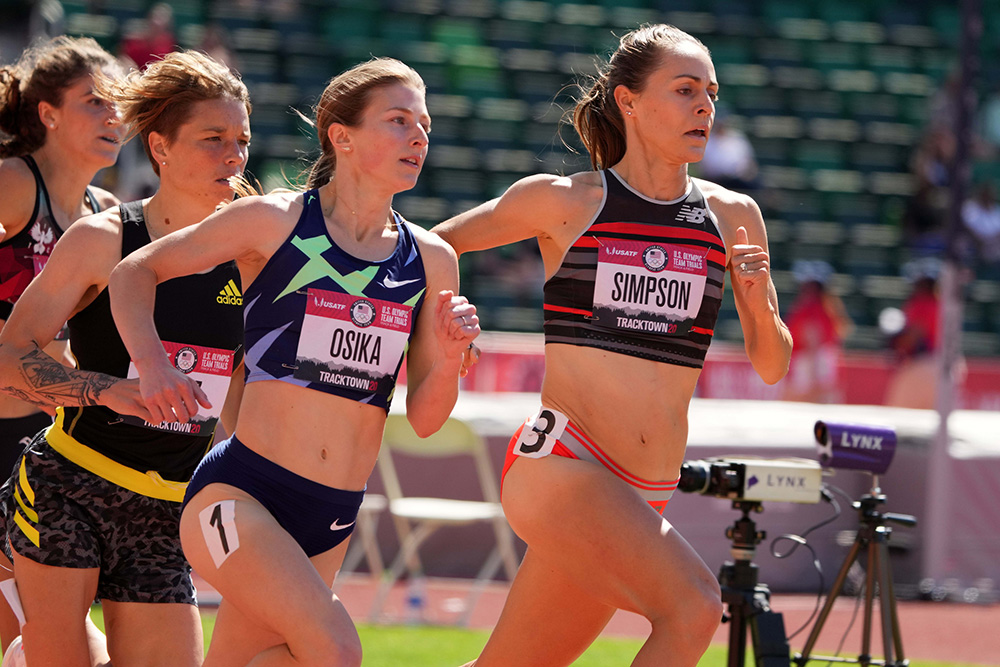
In a stunning incident, Jenny Simpson, the ’11 world 1500 champ who has remained one of the most visible faces in the running community since her ’24 retirement from competitive running, suffered a cardiac arrest and collapsed at the Sir Walter Miler event in Raleigh, North Carolina, in mid-June.
Simpson had apparently just finished pacing one of the mile groups at a pop-up event when she collapsed. She received immediate care including CPR and an automated external defibrillator (AED) before being rushed to the hospital.
After 9 days the 39-year-old Colorado alum was released to recover at home. A statement released by Fleet Feet (she is the company’s Chief Running Officer) read, “Her focus will be on rest and healing… Fleet Feet thanks everyone who has kept Jenny and her family in their thoughts and asks that their privacy continues to be honored throughout her recovery.”
Hodgkinson Needs Her Sleep
Mark down Keely Hodgkinson as one who is not wild about late night races. And don’t get her going on crowded races. The Olympic 800 champion said recently, “We need to put a limit on, no races past 9:30pm, 10pm latest. The men’s 100s are at 11pm [at the Rome DL]. What the hell?
“And no more than 10 people in an 800m, thank you. Really important, that. People are falling over left, right and center. And then some people are running way further than 800m because they’re having to run in lane 3.
“You can’t even say, ‘It gets you ready for the championship.’ No, because there’s never going to be 13 people in a championship race. Thank you. That is my two piece on that for today.”
WADA Continues To Spar With USADA
In the latest installment on the ongoing WADA/USADA bickering thread, the WADA executive committee endorsed a recommendation that during major events such as the Olympics, national drug-testing agencies sit back while independent operators handle the testing of athletes.
Said WADA president Witold Bańka, “It will be beneficial for the integrity of and trust in the system that major events will be protected in this way and insulated from allegations of bias — whether justified or not — by the host country.”
USADA (which was not invited to the virtual meeting) responded quickly, calling this “a dangerous step backwards [that] risks compromising the fairness of major events and athletes’ right to fair competition. Dressing this up as progress is an attempt to pull the wool over the eyes of clean athletes, fans, and the public who deserve real independence, real accountability, and a system that protects them — not one that protects sport from scrutiny and the global anti-doping watchdog from accountability.”
Puma Facing More Legal Battles?
Abby Steiner is not the only one taking Puma to court over running injuries allegedly caused by the German company’s shoes (“Last Lap,” May). Following the Kentucky alum’s April lawsuit against the company, two other former world-class athletes have worked with the same lawyer and filed suits using nearly identical language.
Florida alum Champ Allison was 2nd in the ’22 NCAA 400 and USATF runner-up as well in 43.70. He placed 4th at Worlds that year and won relay gold. Burdened with injuries since, he has only raced six 400s in the years since. Last year his best was 46.15.
Damion Thomas scored gold for Jamaica in the ’18 World U20 Champs. In ’21 he won the ’21 NCAA Indoor hurdle title for LSU, running 13.11 that summer and making it to the Tokyo Olympics. Because of injuries, he has not raced since ’24, when he ran a best of 13.64.
The complaints point to negligent design, negligent manufacture, failure to warn users, general negligence, breach of warranty, and ask for a jury trial and damages to be proven at trial.
In a release Puma has responded: “We strongly deny any allegation that our performance products cause injuries.”
Mixed Signals On Russia
“The IOC stands in solidarity with the Olympic community of Ukraine, which the Olympic Movement has supported since the beginning of the war, and will continue to do so,” trumpeted the release following the July meeting of the IOC Executive Board.
Call that opposite-speak. At the same meeting, new IOC president Kirsty Coventry led the board in officially welcoming back the Russian Olympic Committee. The move comes a month after Russia’s top Olympic official demanded the IOC “End this.” Meanwhile, the war that motivated the ban continues, with a Russian missile attack killing 22 civilians in Ukraine the day before the IOC decision.
Just days earlier, the WA Council reaffirmed its ban on the Russians and Belarussians, a move the Russian federation called “discriminatory.” It is yet unclear whether the IOC move will force WA’s hand with regard to the track events at the ’28 Olympics.
In early July Russia’s federation launched an appeal with CAS in an attempt to overturn the WA ruling that continues to suspend its athletes from international events.
IOC Talking Dialogues
The IOC is adding a new stage to the Olympic bid process to address stakeholder concerns that the organization needs more transparency in its proceedings. The new stage is called the “strategic dialogue” and it will occur between the two stages that have been in use since ’19, continuous dialogue and targeted dialogue.
The strategic dialogue will require select bidders to submit their core financial guarantees as well as a completed future host questionnaire.
For the awarding of the next available Olympics, ’36, the continuous dialogue has already begun. The strategic dialogue will begin in March ’27 when the IOC’s executive board shortlists the parties entering this stage. Then in late ’28, those candidates will enter targeted dialogue, with the emphasis on focused discussions.
The selection of the ’36 Olympic host will follow in mid-2029.
Coventry Backs Payments To Olympians
The IOC’s Kirsty Coventry in her first presidential year has come across as someone who does not want to endanger the IOC’s business model. She recently declared, “It’s nothing new that I don’t agree with prize money at the Olympic Games. There’s prize money at continental games, at international federation games, at World Cups.
“But,” she continued, “at the Olympic Games I feel that we have a broader responsibility to try and find ways to directly support every Olympic athlete that comes to the Games, and I have been asking the teams here internally: How do we do that? How do we increase Olympic solidarity scholarships? How do we find other innovative ways?”
Coventry is now championing a new proposal to award $10,000 grants to Olympic athletes. The payouts wouldn’t come until after each Games, and then they would go directly to the national Olympic committees, in the hope that those bodies would deliver the money to the athletes.
The whole program will cost about $140 million per cycle, — a small fraction of IOC revenue. In the last Olympic cycle, the organization pulled in $12.4 billion. For comparison’s sake, Coventry’s own compensation is well over $10,000. She gets a $350,000 annual stipend, plus a housing allowance. ◻︎
