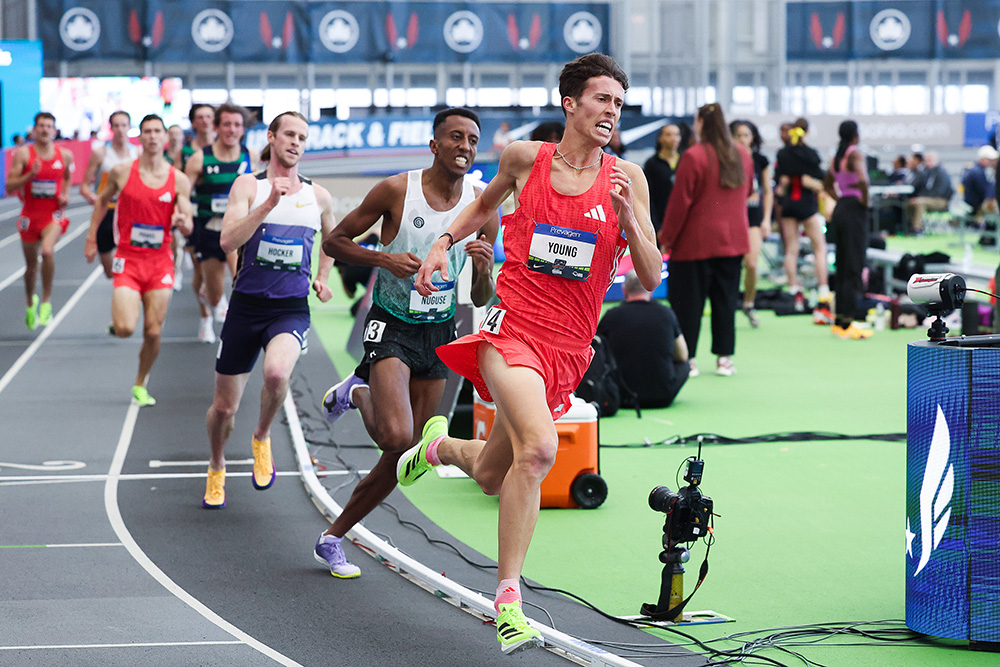
BEING A HIGH SCHOOL SUPERSTAR is all about promise. The future seems unimaginably bright for such prodigies, but sadly, few ever come through on that early promise. Such was the challenge that Nico Young faced coming out of the much-ballyhooed Newbury Park program in California.
He had won the Arcadia 3200 in 8:40.00, the NXN title in cross country in a meet record, and 3 California state crowns. He also set an indoor HSR of 7:56.97 for 3000. In ’19 he led the T&FN HS All-America team at 2M. All this despite being restricted to just two races his senior year because of the pandemic.
He jumped into the deep end at Northern Arizona, a team leader in helping the Lumberjacks win 3 NCAA cross country team titles for coach Mike Smith during those years. He captured two individual NCAA Indoor crowns to boot, at a time when collegiate distance titles are more competitive than ever. (Continued below)
And now he’s a pro, running for adidas. In his first season he showed his promise coming to fruition. On a balmy night in Oslo last summer, he unleashed a furious kick that left the top Ethiopians behind, hitting the line in the fastest-ever U.S. outdoor time, 12:45.27. It was the first major 5000 that an American had won in a fast time in Europe in nearly 50 years (echoing Marty Liquori in Stockholm ‘78).
Then at the World Championships in Tokyo, Young went for the double, placing 5th in the 10,000 and seven days later, 6th in the 5000. Only 10K champ Jimmy Gressier of France (bronze in the 5000) handled the dual task better.
Now Young prepares for another campaign, with an eye toward winning everything that he can, in hopes of being ready for the podium at the ’27 Worlds. He talked to us just after news of the London Marathon hit, in between Flagstaff training sessions and walks with Randolph, his blue heeler/husky mix.
T&FN: Six years ago I interviewed you after your 2-race season, your senior year in high school. Where you are now in the sport, would that surprise the person you were then?
Young: Yeah, I would say so. For me, in high school I was running very well at the level that I was competing at, but it would have been hard to imagine, the level that professionals are competing at just in terms of paces of races and that type of thing. So, if I would have thought that I’d be running as fast as I am now I would have been surprised. It would have sounded not doable at the time which it wouldn’t have been, but it would have sounded crazy.
T&FN: You have come so far since then, it’s mind-boggling. You are a rarity in some ways, as the high school superstar who finds success in the NCAA, then successfully transitions to the pros. There are so many other big names who ran into pitfalls along the way. How did you avoid all the things working against success and come to where you are?
Young: First of all, I’ve gotten very lucky with injury. That’s kept me healthy. Since high school the consistency with that has made a tremendous impact on my development as a runner, being able to just have pretty much consistent year after year of training. I feel like it’s a huge thing. A lot of people have a lot of injury issues that come up. I’ve been especially lucky to not have any kind of stress injuries.
But also I’ve had a very good group of people in my corner that support me and have helped me navigate the pressure that can come from running well in high school and then getting into a whole new field of competition in college and then again as a pro navigating that pressure and expectation that comes with that. They’ve helped me become the person that I feel like I am today with those things. I’ve definitely been lucky.
T&FN: Is the lack of serious injuries surprising in light of your early high school years when you were injured a lot. Was it just luck or maturation that helped you get past all that?
Young: I think maturation. When I was early in high school, I was growing a ton. I think I was 5-1 my freshman year and by the time I graduated high school, I was 5-11, so I think a lot of those early injuries I can attribute to just developing as a human being. And then yeah, I feel like I had a lot of resources to help me stay healthy when I did have things come up because it’s not like I didn’t get injured or didn’t have issues. But I had really good resources to help me with that so I still had times when I’d miss months of training, but I was able to keep that pretty insignificant.
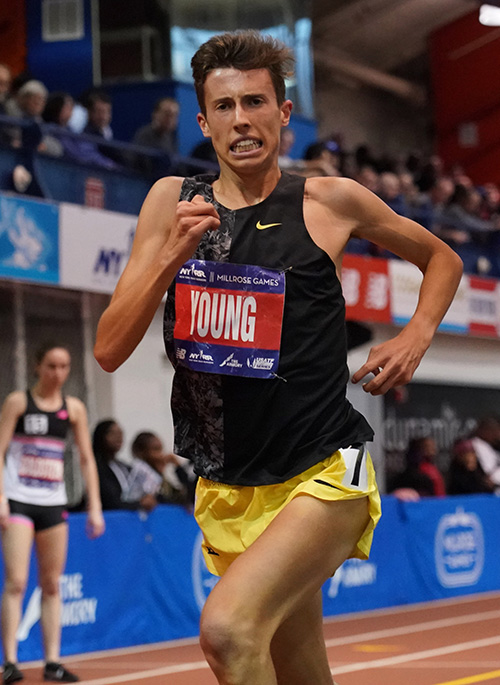
T&FN: Would you say that your Newbury Park days were a pressure cooker of sorts compared with what other runners have experienced at that age? All the media attention you guys got was quite extreme.
Young: It was a bit crazy. I mean it was something I’d never experienced before so there were a lot of new things I had to navigate. But I feel like we did a good job. We had a lot of kids and people come up to us at meets, which actually only kind of got more exaggerated after I left Newbury Park.
With my younger brothers, it got even crazier, but we were able to kind of keep the competitive environment private and then there were times after the race to engage with fans and interviewers but it was definitely a new thing to navigate. I feel in high school I learned a lot that I took into college and was able to implement.
T&FN: You went from a high-profile high school program into the deep end collegiately at Northern Arizona and were a factor in your first NCAA races. Was that transition smooth or were there bumps in the road?
Young: I feel like it was pretty smooth. My freshman year of college I guess I did have an injury then that lasted like 1½ months where I didn’t run which I guess isn’t very long compared to some other injuries, but that was definitely a bump right after I got to NAU. I feel like it was pretty smooth from there. I mean, Sean [Brosnan] in high school was very good at developing me in the right way so that I could transition to college training pretty seamlessly.
I was already running decent mileage and my workouts were intense so the next step was pretty fluid and I was able to get right on that stage of being competitive in the NCAA. I feel like the high school transition really helped me jump right into it.
T&FN: In your move to the pros, you stayed in Flagstaff with the same coach. Has your lifestyle changed much at all?
Young: I feel like it’s mostly the same. I’ve cut out obviously the school portion so that’s the biggest change. In terms of our training and team environment, it’s very similar to what it was in college, but I would say another level up in intensity now as a pro, because we have extra time and resources to raise that to a new level, which makes sense.
T&FN: Who are your key training partners these days?
Young: Right now I train the most with Parker Wolfe. But everyone in our group I go in and out of doing workouts with, and we have like 10-ish guys. Even some of our 800m athletes I’ve done workouts with.
T&FN: Looking back, when you moved up to 10,000 in 2024 and experienced almost instantaneous success, did the smoothness of that step up surprise you?
Young: After some of the indoor races I had run in December of that year, I wasn’t surprised. The trajectory was kind of pointing in that direction. It still surprised me but it made sense for the progression that I was on, in comparison to how I had been running in previous years. I hadn’t raced a track 10K until my senior year, but it would have been shocking if you told me what I would run in the 2024 outdoor track season.
T&FN: In 2025 the race that stands out for a lot of people is your win at the Bislett Games 5000 in an American Record 12:45.27. What about that race stands out the most to you?
Young: I went to that race having no expectation of how well I was going to perform, never mind winning the race. With like 200-ish meters to go or maybe 300 going into 200, I made a split-second decision to take the lead. That daring decision stands out the most to me, because if I didn’t do that and I stayed complacent and didn’t think that I could win, I probably wouldn’t have won. So that was a very important decision that I made there at the end of the race.
T&FN: In terms of making you who you are as an athlete, the learning process or the building process of what created the Nico Young 2026 version, what was the most important race of your life?
Young: I’m not sure [long pause]. I feel like there are definitely a lot of them but one that comes to mind right now that I think was very telling of who I am as an athlete was when I raced the NCAA XC Championships my freshman year of college in the winter. It was moved to the winter because of Covid and all that. I was injured for three weeks going into it and didn’t run for two of those weeks. And I was fourth at the championship. I remember talking to Coach Smith the day before that race and asking him where he thought I would place. And he’s like, on a great day this and on a good day, this is probably what it is.
I remember thinking like, “OK, why can’t it be a great day?” So I decided to go for it, even though the lead-up was not ideal, and I finished 4th. It was a really difficult race. I was a freshman and it was my first NCAA Championship so I feel there’s a lot of evidence that I can pull from that race when I was so young and inexperienced that helps me now. I’m like, ‘‘Oh, I did it then when I was really inexperienced and had a lot of pressure on myself and an imperfect lead-up and I still was able to execute on the day regardless of the place.” The place was really good. But that came with the effort.
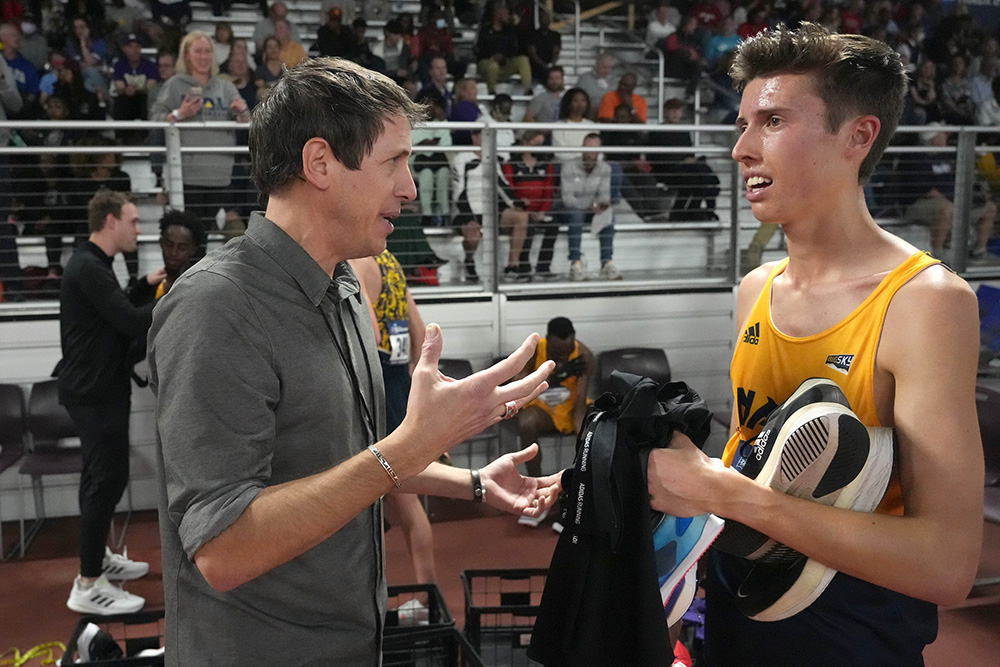
T&FN: Last year you doubled in Tokyo and were in the mix in both the 5000 and 10,000. What did you learn in that process? Assuming your goal is like everyone’s, to make that podium someday, what did you take away from Tokyo?
Young: I feel like the biggest takeaway was that in both of those races, I was able to be in a medal position, but I feel like I wasn’t sharp enough or fit enough or in the place where I could close as well as the guys who were winning medals. I think I could but it was I feel like those races were just on the edge of where I could be. I’m able to close just as hard as everyone else. It’s a really good checkpoint in my development because the year before in Paris I wasn’t there at the end to be able to close with the front, and now I was not quite at that level so I feel like that’s been developing the past year and now going maybe into the 2027 World Championships, that’ll be a bit different.
T&FN: Is that part of the motivation behind the 3:48 mile you ran this winter? Has there been a little bit more emphasis on speed and building your kick?
Young: That’s something that I always try to emphasize with Mike. We’ve been working on that since he started coaching me in college. That’s been developing for like ever since then. But definitely I think now you have to be good at the mile to be good and competitive in the 5K and the 10K. So I like to run races like that mile. I think they’re fun as well, but they definitely help the longer ones.
T&FN: When you’re racing is there an aspect of you that comes out that’s not there in day-to-day life?
Young: I would say slightly. I mean, it’s a race environment, so I feel like I’m much more competitive there than I am in daily life. The race is about who can win the race. That’s not really the best mentality to take to everything but I feel like I don’t really bring a totally different person to the race. I feel like that’s who I am in my day-to-day life as well.
T&FN: This year it’s kind of wide open in terms of no real big medal opportunities beyond the World Ultimate Championships. What are you looking for out of this season?
Young: I’m not racing very many times, so I think the races that I’m in if I can be in place to compete to win all of them, that would be awesome. I’d love to be at the World Ultimate Champs. That’s quite far away, so I don’t know exactly what that will look like but that is my end of season goal with it being an off year.
T&FN: What was the recent World Cross Country Champs like for you?
Young: That was a tough race. I don’t think I was fitness-wise ready for that competition at that time of the year. I was kind of thrown into it and had to kind of work with what I had. But it was as cool being back at the Tallahassee course where I had won a team NCAA title at NAU, and running cross country again. I don’t think it was quite like what I expected. But it was exciting and it was really cool to be on another U.S. team.
T&FN: Today seems like the perfect day to ask about the marathon after the news from London. Is that something you ever see yourself going toward?
Young: Yeah, I would say so. I have no idea when. I’d like to be on the track for as long as possible. But I’ve thought about the marathon before and I think I’d be very good at it. I’m not sure yet, but it is a cool event.
T&FN: Many of the top African marathoners have specialized in the event since they were young, while most Americans do the NCAA thing, then work the pro circuit on the track and then don’t move up until maybe they’re perhaps past their prime for marathon potential. Do you think Americans start too late?
Young: I think if people started their marathon career when most people start their track career, the marathon would be much more stacked, it’d be much more competitive. But I think for a lot of people it makes the most sense to transition later on. For the longevity of someone’s career at least that’s the advice that I’ve been given. Moving up in distance is easier than moving back down. That’s why I saved my first track 10K for my senior year of college and since then I’ve only actually run five 10Ks, but I think it makes sense along the progression to have the longest and most sustainable career. There are plenty of people who do start the marathon earlier and have successful and long careers as well, but I think for someone like me who’s running very well on the track, this makes the most sense. □