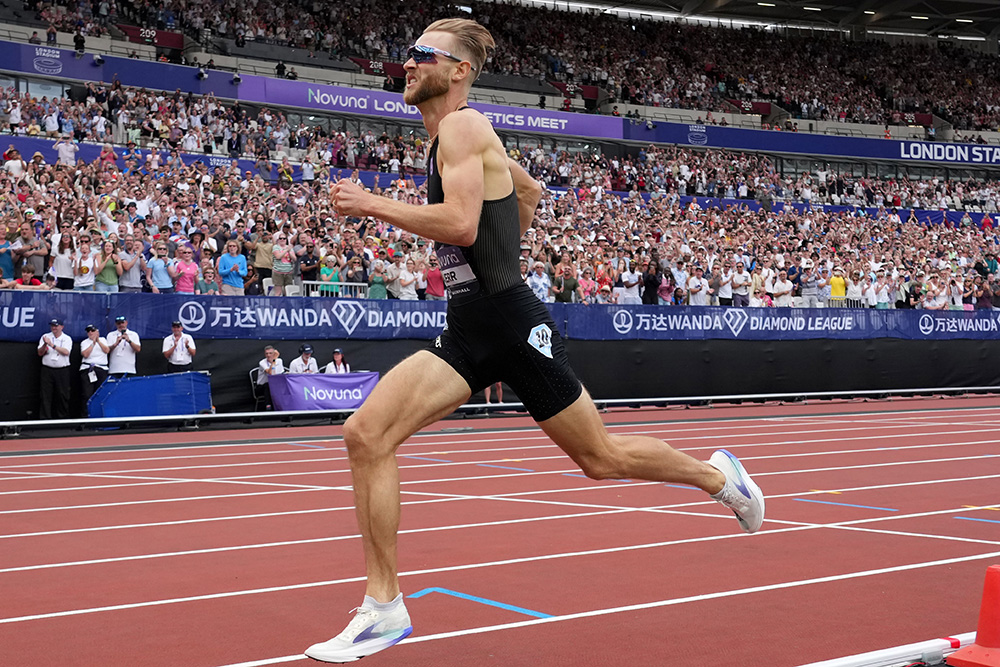
STATISTICALLY SPEAKING, Josh Kerr and his team could hardly have made their target at the London Diamond League simpler. Four 440-yard quarters of 55.5 for a total of 222 seconds or 3:42.0. Not so easy to achieve, but clear for all to understand. Preparing the requisite statistics for a televised attempt on the mile was still quite a task, even though in my case the commentators Steve Cram and Paula Radcliffe already knew quite a bit about World Records themselves.
Steve himself, of course, broke the mile World Record in ’85 (3:46.32), with an extraordinary 14.03 for the last 109m. It had been 69 years since the men’s world mile record had been broken in Britain, when Derek Ibbotson clocked 3:57.2 at the White City Stadium, around 12M from this year’s London venue. A then-record of four men broke 4:00 in that race.
Statistics in this context are not only numbers such as pace schedules and dates, but tidbits which help set the scene. Thanks to team Kerr’s transparency, we knew exactly what he would be doing at around 12:30, three hours before his start time: drinking his first cup of coffee in eight days. “A coffee about three hours before the race should then have more impact,” he explained in one installment of his fascinating build-up diary in The Daily Telegraph. An important pointer for me came about 2 hours after Kerr’s coffee time, when Brandon Miller, also coached by Danny Mackey, won the 800 easily from a strong field.
The core of my job is to provide brief but thorough notes on every starter, including pacemakers. It is tempting to concentrate only on the principals, but you can never know who might be in the spotlight in a distance race, as the unheralded Billy Fordjour proved at Munich ’72 when he accidentally tripped Jim Ryun. Happily this race went without any such incident, though it was a pity that Mohamed Abdilaahi dropped out in the last 300 after being a brave 4th at the bell.
A statistician can’t watch a race like other fans. I was then focused on an attempt to estimate Kerr’s time at the three imperial points which fell within that 9-meter stretch between the mile start line and the finish. Kerr cuts a distinctive figure with his floppy hair and sunglasses, but was still a blur as he passed through that zone. Again, it helped that the published plan slotted into pace perfectly.
The race was a procession, with the column headed by “PACE” (Brannon Kidder), then “PACE 1” (Žan Rudolf). And then to the roar of the crowd, Kerr himself with precisely 600m remaining. Metric or imperial, he was on schedule and this was duly conveyed to 60,000 spectators by Geoff Wightman, and by Cram and Radcliffe to their British TV audience. Even though the race was an orderly queue of men, it was still thrilling to see Kerr striding out on the last circuit, pulling clear of the opposition and moving ahead of the pace wavelights.
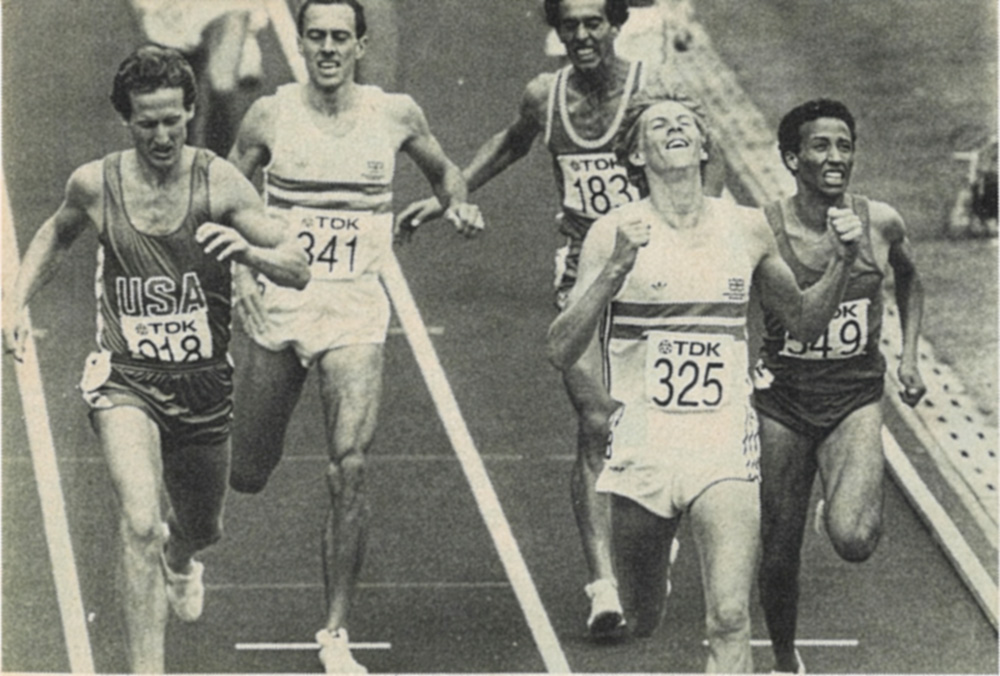
Then came the moment we could all be certain the record was on. Swiss Timing had agreed to briefly freeze the stadium clock at 1500m. At the press conference I had doubled-checked with Kerr that his pace plan required that he would probably break his UK 1500 record (3:27.79) en-route. He agreed but added “let’s not get into that.” Cell figures 3:27.51 came up for a few seconds. That time was later corrected to 3:27.62 but it didn’t matter, it was indeed a national record and clearly faster than El Guerrouj’s 3:28.21 split 27 years earlier.
The London Stadium is now sadly devoid of any trappings of London 2012 but the noise and reverberation on that last lap took me back to when Mohamed Farah won his Olympic 5000 gold.
How fitting that Sebastian Coe, the last to break British records at 1500m and a Mile in the same race, was there to congratulate the new WR setter. The man who brought the 800 into the 1:42s was on hand to see the mile enter the era of the 3:42s.
A further juicy stat was that Kerr was the first to run a mile quicker than the world best 1500m time of 3:43.0 Roger Bannister clocked during the first sub-4 mile. So virtual Bannister wouldn’t have even been in the finishing straight when Kerr crossed the line. Besides the records, Kerr achieved the unlikely feat of getting athletics on the front page of a British newspaper on the weekend of the World Cup [men’s soccer] finals.
Other WR contenders have done their best to avoid any extra pressure in their buildups. Kerr savored his position under the magnifying glass, predicting then delivering the numbers in front of thousands. He talked the talk then walked the walk in a way I’ve never seen in the 50 years I’ve been casting my eyes on the statistics of athletics.
