WHEN THE SUBJECT of hand/auto timing conversions came up again after having laid dormant for so many years, I have to admit I cringed. That’s because it would inevitably mention one of the few things that genuinely triggers me: 0.24.
To explain, first let me tell you where that came from, and where I’m coming from.
The 0.24 hand/auto timing differential, much publicized by this magazine in the ’70s and the decades since then, originated from an academic study done of the expert timers who worked at the track & field events at the 1972 Olympics in Munich, Germany.
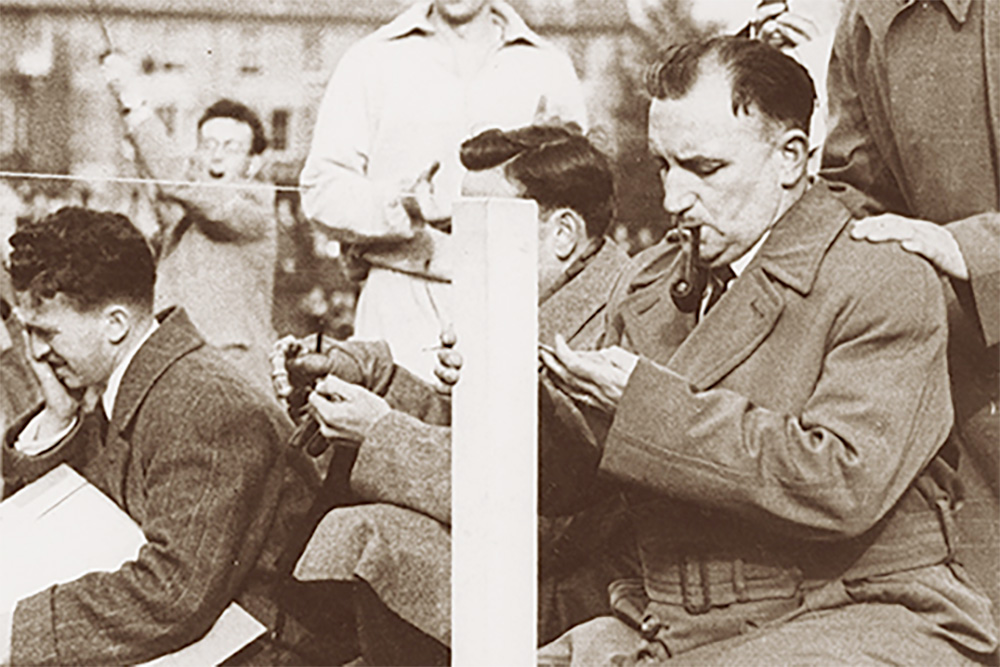
As such it is an accurate study of human reaction time. Note that there was perhaps a difference in how the German timers were trained compared to the British hand-timers of the era, who were famously conservative. Or even, to go way back, to the University of Michigan’s Phil Diamond, the German professor who was the head timer when Jesse Owens had his “Day of “Days” at the 1935 Big 10 meet. Diamond railed against those who anticipated the finish and instructed his timers not to click until they saw “the leg that carries the weight of the runner” cross the line.
The 0.24/0.14 differentials held up well with the U.S. hand-timers at the ’76 Olympic Trials, according to an informal study done there by one of our founders, Bert Nelson.
To be clear, I have no argument with the use of 0.24/0.14 with regard to trained timers. However, in these waning days of hand-timing, the subject usually only comes up with high schoolers, and usually only when the automatic timing system fails. Then the 0.24 conversion becomes terribly problematic.
I’ve long been a fixture at the state finals in Michigan and have announced most of the D1 versions for the last 20 years. Back when we had a team of hand-timers working alongside our FAT operator, I would make sure I got a copy of all the hand times so I could do my own informal comparisons. Every time I ran the numbers, I got average differentials of between 0.40 and 0.45, with outliers that raised eyebrows.
It could have been that the hand-timers, knowing they were just a back-up and their times likely wouldn’t count, got sloppy. It could be that they weren’t trained German or British officials known for their precision — instead they were mostly parents whose only training was having their kid run track. In any case, the inaccuracy of high school timers when combined with the 0.24 conversion has led to some serious abuses.
I’ve seen regional qualifying meets resist using FAT for years because their hand times, plus 0.24, would net the coaches more state qualifiers. I’ve seen FAT go down for several heats at a championship, and those heats, once 0.24 was applied, would have a big advantage in qualifying for finals (and getting better seeds). And so on.
Speaking of cringing, more than 50 years after the Munich Games, 0.24 still appears as the conversion factor in the NFHS high school rulebook. Yes, it’s based on good science. It just doesn’t apply to high school timers. And I can speak from authority, as the only person I know of who has ever been kicked off a high school hand-timing team at a dual meet for timing too slow!