THE 7:30 A.M. START of the Chicago Marathon comes just as the sun begins to rise over Lake Michigan. Boom! And they are off and running. Also appearing just over the horizon for this go-round in the Windy City was the prospect of the 2028 Olympic Year. Based on strong performances by U.S. runners, it’s going to be a fast and exciting 17-plus months leading up to the March 25, 2028, Trials in St. Louis.
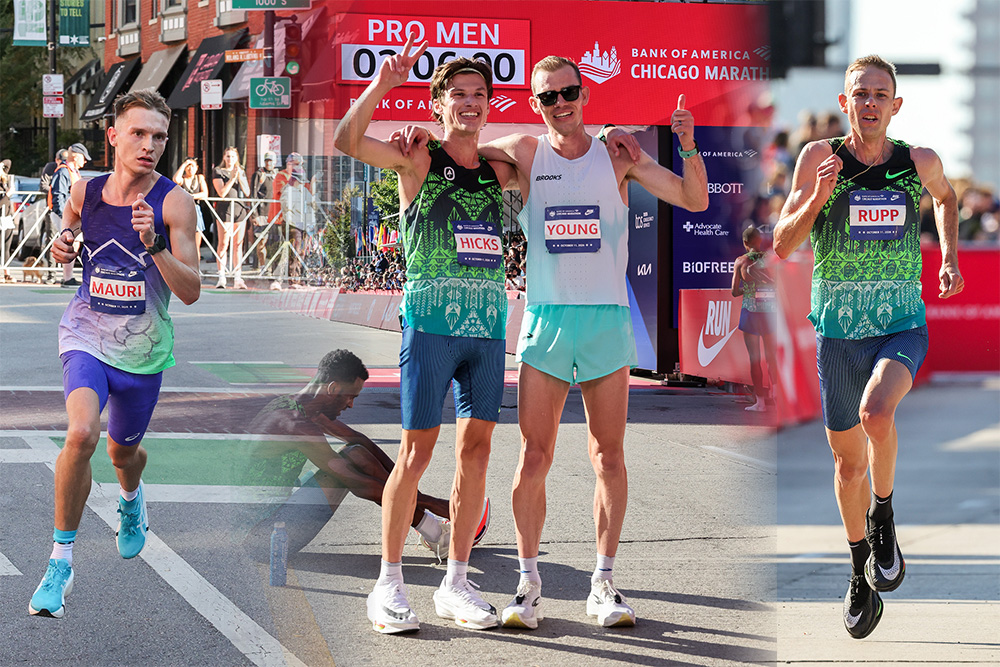
On the men’s side, Clayton Young and Charles Hicks backed up their fast aided clockings in Boston with legit 2:05:23 and 2:05:35 efforts to duck under Khalid Khannouchi’s former AR that stood for 23 years until Conner Mantz took it down at Chicago a year ago. Now only Mantz’s 2:04:43 time stands ahead of Young and Hicks at 2-3 on the U.S. list.
While Young and Hicks never threatened Mantz’s AR, treadmill training phenom Vincent Mauri gave it a great scare running low 2:04 pace through 30K. Stopping several times to stretch Mauri finished his second marathon effort in 2:06:45 good for 10th place in his first WMM.
Finishing 10 seconds back of the relatively unknown Mauri was the most well-known U.S. marathoner, a healthy 40-year-old Galen Rupp looking to partake in his fifth Olympics and third marathon team.
Let’s start with Mauri, the 25-year-old who led the American charge for most of the race. “I felt very good early, and settled into the 62:20 group for about 10K,” he says. “I was getting a little bit antsy because the legs felt great. At 9 miles, I decided that I’m just going to run my own race. I was bumping into the pacers a little bit, bumping into Charles and Clayton, so I just wanted to pick it up.
Passing 15K in 44:24, Mauri sped 2:55 Ks to split 43:51 for the second 15K and reach 30K in 1:28:15 — 2:04:08 pace.
Mauri recalls “After that first hour, I don’t quite know what this next hour holds, but let’s at least give a shot of doing something remarkable. And I ended up paying for it later in the race. I had a couple hamstring cramps come up, and stopped a couple times to stretch.”
What a wild sight it was in the 36th K (around 22 miles) when Young and Hicks caught Mauri as he stretched on the side of the course only to have him scurry back onto the road to run with them until his hamstring balked.
Mauri competed for Arizona State and Notre Dame, running 3:59:05, 7:50.33 and 13:34:03. He has proven to be a wild card among the U.S. contingent, ready to shoot for the moon at any chance. “I’m getting to do what I love, and I have a very good idea of what I have to fix for next time, but hey, 2:05 for the first one and 2:06 today with a couple stops. How could I ever be upset with that?”
Both Young and Hicks were quick to acknowledge that Mauri’s bold racing pulled them to their PRs.
The 25-year-old Hicks recalls, “When Vinny went, that was when things got really interesting. I was content to sit and just feel good but I saw Vinny was on [AR] pace, and we were off. So, maybe if we catch him we have a chance. So I pushed to catch him.”
Young and Hicks ran together through a 62:32 opening half and were on 2:05:10 pace when they caught the cramping Mauri just past 35K (1:43:49).
Catching Mauri was one thing. Finishing the last 7K as heat and humidity took hold was another. “That was definitely the hardest part of the race to manage,” Hicks confessed. “I just felt like my body was maxed. I really just tried to reach for it but I didn’t quite have that turnover.”
The two ran together until Young made a break from 5K out. “I saw the guy that was ahead of us,” he says, “and that’s what gave me the guts to break away from Charles. I decided to pull towards that guy — and before I knew it, I gapped Charles a little bit, and he closed.
“Then I was like, I’m going to count to 100 seconds, press as hard as I can and see where I’m at. Well, I gapped him enough to where, I was like, OK, let’s do another 100 seconds.”
Young held his advantage to the finish and the 33-year-old ’24 Trials champion who openly targeted his training partner’s AR had to settle for a big PR. He had dinged his hamstring finishing the Great North Run a month earlier. His time to heal the injury was almost impossibly short.
At the finish line there was a lot of dude speak between Young and Hicks about their shared experience. “I don’t even know what to take from today,” Hicks wondered. “I’m very proud, but it’s complicated.”
Not complicated for Young: “Dude, we’re official 2:05 guys,” As the pair exchanged high fives, Hicks asked, “Where does that put us all-time U.S.?”
Informed of Khannouchi’s 2:05:38 time, Hicks exclaimed “We snuck in, second and third.” Young smiled, “I’ll take it, as Hicks took stock: “Third in my third marathon, I’m amazed.”
Running a few hundred meters behind the leading Americans, Rupp essayed a long solo run back to relevance. Having banked his fastest time since 2021, the Rio Olympics bronze medalist couldn’t hold back a smile. “I’m thrilled!” he declared. “I really thought for sure I could run under 2:07 and this is the first time in years that I fully trusted my body. I wasn’t thinking about my back and my hips or all these things that have been such big problems.
“This was a big step forward to me for me today, a lot better than in the spring when I ran in Boston [2:08:15 for 22nd]. I probably went out a little bit too quick the first 10K, but I was pretty much by myself after halfway. Going forward, what stands out was probably the way I competed in the last few miles. I don’t think anybody passed me from behind, and I caught several guys.”