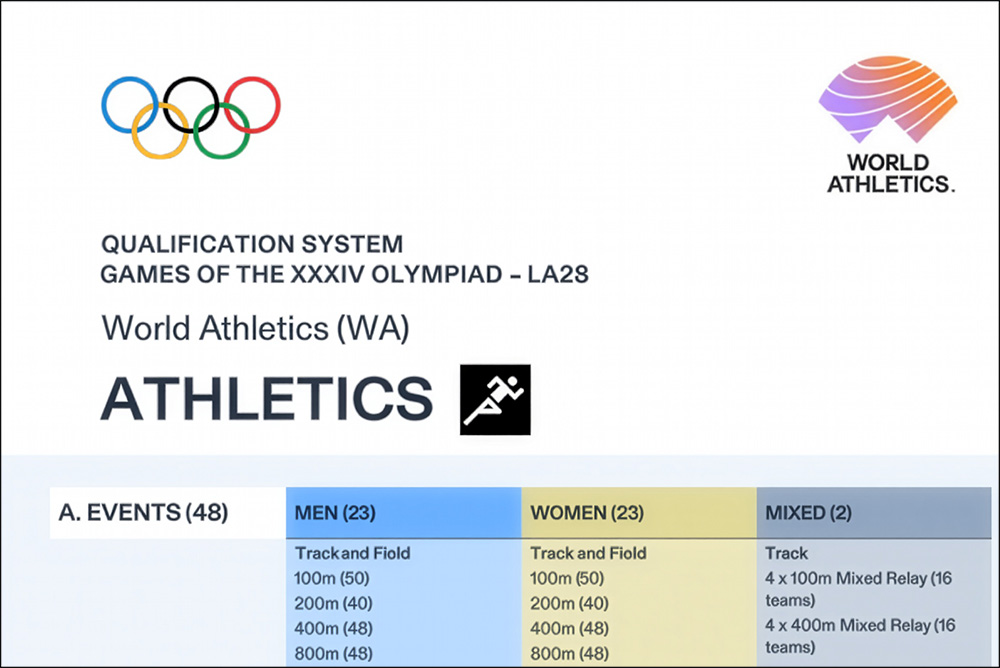
IT’S NOT JUST the “brutal track & field qualifying process set out by World Athletics for the LA28 Games,” writes Rich Perelman, editor of the ever-informative Olympic sports website/newsletter The Sports Examiner. “The entire 2028 season will be different…”
In the article below, republished with permission, Perelman lays out several reasons why. (Here is a link to his analysis as it appeared originally on The Sports Examiner site. T&FN’s precís on the Q protocol can be found here.)
≡ LA28 QUALIFYING ≡
For decades, if you ran a Olympic medal-class time or produced an all-time performance in the field, you could be assured of being qualified for entry to an Olympic Games. That may not be the case any more.
World Athletics released its qualification program for the 2028 Olympic Games in Los Angeles and is intent on ensuring that the overall track & field quota of 1,810 athletes is not exceeded. So, with qualifying by (1) time or mark or via (2) World Athletics world rankings (which emphasize athletes running in more meets to earn more points):
“[T]he qualification system is based on a dual pathway. Rather than the previous 50/50 model, 40% of athletes are expected to qualify through entry standards and the remaining 60% are expected to qualify through world rankings.
“Should more athletes than the quota by event achieve the entry standard, qualification will be limited to those with the best performance in the qualification period, and within the quota number, thus achieving the entry standard does not automatically guarantee a quota place. In this case no athletes will be qualified by world rankings.”
That’s a bad scenario for the athletes, but the remedy is to make the qualifying standards so high that such a situation is highly unlikely. That’s what happened: looking at the world outdoor lists for 2026, consider the 2028 qualifying standard and how many made it this year, vs. the 2028 quota:
| Men | |
| 100 | 9.93 for 50 quota places (26 achieved this in 2026) |
| 200 | 19.95 for 40 (19) |
| 400 | 44.40 for 48 (21) |
| 800 | 1:43.00 for 48 (9) |
| 1500 | 3:30.00 for 45 (5) |
| Steeple | 8:07.50 for 30 (9) |
| 5000 | 12:50.00 for 42 (10) |
| 10,000 | 26:48.00 for 27 (0) |
| Marathon | 2:05:00 for 70 (46) |
| 110H | 13.18 for 40 (21) |
| 400H | 48.00 for 40 (15) |
| — | |
| High Jump | 2.32m for 32 (4) [7-7¼] |
| Pole Vault | 5.90m for 32 (13) [19-4¼] |
| Long Jump | 8.30m for 32 (11) [27-2¾] |
| Triple Jump | 17.35m for 32 (7) [56-11¼] |
| Shot Put | 21.50m for 32 (10) [70-6½] |
| Discus | 67.20m for 32 (21) [220-6] |
| Hammer | 78.50m for 32 (17) [257-6] |
| Javelin | 85.50m for 32 (10) [280-6] |
| Decathlon | 8650 for 24 (2) |
So in 10 of 20 men’s events, 10 or fewer made the qualifying mark in 2026, and three more had 15 or fewer, well short of the 40% target. Special rules are in place for the marathon, where a top-5 finish at a World Athletics Platinum Label Race is considered to be qualification regardless of time. Walking events will not use times for qualification at all.
| Women | |
| 100 | 10.96 for 50 quota places (24 achieved this in 2026) |
| 200 | 22.25 for 40 (18) |
| 400 | 49.90 for 48 (15) |
| 800 | 1:57.00 for 48 (12) |
| 1500 | 3:57.50 for 45 (13) |
| Steeple | 9:06.00 for 30 (8) |
| 5000 | 14:34.00 for 42 (14) |
| 10,000 | 30:30.00 for 27 (1) |
| Marathon | 2:22:20 for 70 (78) |
| 100H | 12.58 for 40 (21) |
| 400H | 54.00 for 40 (15) |
| — | |
| High Jump | 1.97m for 32 (8) [6-5½] |
| Pole Vault | 4.80m for 32 (11) [15-9] |
| Long Jump | 6.90m for 32 (10) [22-7¾] |
| Triple Jump | 14.50m for 32 (11) [47-7] |
| Shot Put | 19.30m for 32 (14) [63-4] |
| Discus | 65.00m for 32 (14) [213-3] |
| Hammer | 74.00m for 32 (18) [242-9] |
| Javelin | 63.80m for 32 (7) [209-4] |
| Heptathlon | 6550 for 24 (4) |
For these 20 women’s events, six have 10 or less qualifiers and a total of 15 have 15 or less, well short of 40%. While the marathon is over quota, this is not an issue because so many are from Ethiopia and Kenya and each country is limited to three entries.
Further, qualifying marks for qualifying or world-ranking points must be made at a World Athletics Category C competition or higher. What does this mean? Beyond the Diamond League or area (continental) championships, this means Continental Tour Gold, Silver and Bronze meets, but only in events in which prize money is awarded.
Translation: expect to see a lot of Continental Tour Bronze meets with very modest prize money in early 2028.
Happily, the NCAA Division I Championships are included as a qualifying meet.
And athletes are going to have to get ready much earlier: the end of the qualifying period is early, at 18 June, as track & field at the LA28 Games starts on 15 July. A national championships meet used for selection which starts by 18 June will have results counted out to 22 June. Yep, the U.S. Trials in Eugene are from 17-22 June.
The entire 2028 season will be different as the Games are early, the qualifying period is early and the system adopted by World Athletics pressures athletes to compete for ranking points as often as possible. With the exception of some superstars, those who make it to the 2028 Games may already have earned a medal in survival. □
