More Collegiate News
With the THE NCAA Championships right around the corner, let’s check out what else has been happening in the collegiate… Read More
With the THE NCAA Championships right around the corner, let’s check out what else has been happening in the collegiate… Read More
by Bret Bloomquist Saruni On Familiar Path Michael Saruni lacks the element of surprise—that out-ofnowhere factor that fellow Kenyan Emmanuel… Read More
by Roy Conrad The New Balance GP wound up with a pair of fine 3000s, one won by Jenny Simpson… Read More
Edward Cheserek breaks through a mile barrier
by Jeff Hollobaugh Bowerman TC Pair Climb All-Time List Shelby Houlihan & Marielle Hall are thriving under the tutelage of… Read More
by Jeff Hollobaugh Youngsters Taking Their Shots Jordan Geist & Tripp Piperi are opening eyes in an event where older… Read More
by Rich Sands The 111th edition of the Millrose Games got a jolt of energy from two World Records, that… Read More
by Jeff Hollobaugh Schweizer Back Setting PRs If after her 11th-place finish at the NCAA XC last fall people thought… Read More
by Rich Sands After almost 2 decades of being a signature stop on the indoor circuit, the Armory Collegiate Invitational… Read More
Another Near-Miss Donavan Brazier is philosophical about yet another near-miss at the American Record in the 800. “To come close… Read More
by Jeff Hollobaugh “You know,” says a reflective Christian Coleman, “That’s something you dream about as a kid growing up…. Read More
Christian Coleman blazes a WR 6.34 in the 60
by Dave Hunter Nageotte’s Excellent Adventure Day 3 of the ’18 indoor nationals is a day that Katie Nageotte will never… Read More
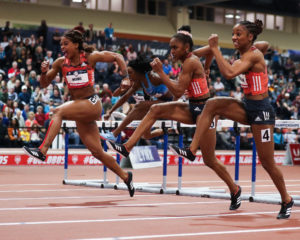
With no Olympic Games or outdoor Worlds on the ’18 calendar, the USATF Indoor Championships took on added meaning as… Read More
During the just-completed Winter Olympics, one figure skating fan on our message boards tried to simplify the scoring system for the non-cognoscenti. His analysis included this:
“Regarding a landed double vs. a fallen triple, here is how it works. A triple toeloop (the easiest triple) is worth 4.3. If you fall, you get -2.1 for Grade of Execution (GOE) and another -1 for the fall. So it gets 1.3. For a triple Axel (worth 8.5), the minimum you could get is 4.5. The maximum you could get for a double Axel is 3.3 (base value) + 1.5 (GOE) for 4.8. So this is still better than the worst triple Axel.”
