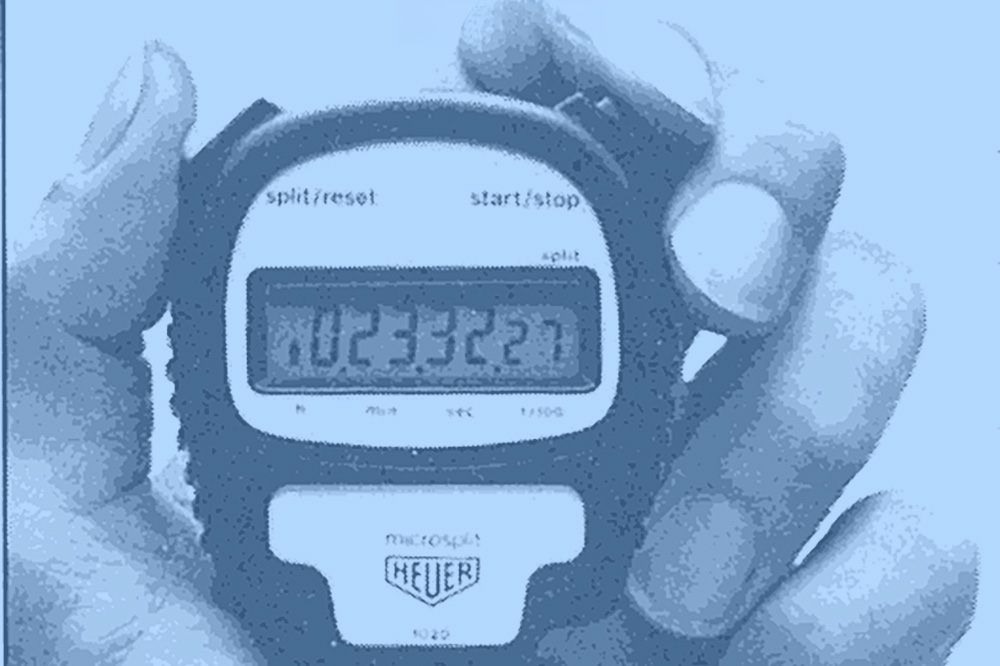
HAND TIMING with stopwatches has largely receded into our sport’s history. Sure, you can find coaches (with whistles hung around their necks), stadium announcing crews and a few spectators of an age holding fast to tradition and their watches. They might beg to differ.
For the most part, though, time in the timing world has marched on.
Soon, if it hasn’t already happened, the convention for converting sprint and hurdles hand times to auto-equivalents will be forgotten, or never learned, by the denizens of the track world. If that doesn’t ring a bell, perhaps the figures 0.24 and 0.14 will.
In eras past, before ubiquitous digital timing systems, those conversion factors (explained below) carried a lot of weight. They had to because most meets were timed with hand watches.
Through their ubiquity, 0.24 & 0.14 also promulgated a myth about comparing hand to auto times. That myth doubtless did its part to deplete the ranks of skilled hand timers.
T&FN explained the problem long ago on pg. 43 of the March 1987 issue in a short article titled “Hand Timing Not Necessarily Faster.” Heck, if you’re one of the aforementioned “of an age” track nuts, you may wish to check it out. You might even learn something.
If you’re too young to know what any of is all about, consider it to be a history lesson. Read on.
Hand Timing Not Necessarily Faster
from the May 1987 issue of T&FN
OK, it’s our fault (at least partially). We admit it. We’re party to the creation of a myth. The myth is that hand timing is supposed to be faster than automatic timing.
NOT TRUE.
“But why, then,” you’re probably asking yourself, “do you convert marks by adding 0.24 to the 100, 200, 100H and 110H, and 0.14 to the 400?”
Good question, and the genesis lies in extensive international research into reaction times. It was discovered that those figures represent the average reaction time it takes to get your watch started after the gun’s flash.
Because one can anticipate an athlete’s crossing the line with great accuracy, there is no reaction time at the finish end. Or is there? If you are timing properly, there should be an equal reaction time at the end, producing a hand time about the same as that recorded by the automatic camera.
Very few people time correctly in this country, or, in fact, in just about any country but Britain, where timers have to go through a formal grading process to time various levels of competition. They do a very good job of masking their reactions. (See box)
The levels of competence in this country vary from site to site. One conference we won’t name regularly sends us both hand and auto results, with variations up to 0.50 not unheard of!
So, the addition of conversion factors is just an averaging, not a firm scientific factor. We don’t like it, but we’re stuck with it, particularly now that the IAAF [Edit: now WA] has given great credence to the method by coming up with hand-scoring tables in the multi-events which reflect these differentials.
We’re sure there are skeptics out there who don’t think that good hand timing can approximate a camera. All we can say is try this experiment. The next time you time a sprint race (begin with an insignificant one, as you aren’t going to see much of the competition), cover your vision on the starting end, leaving your first view right on the line. Then hit your watch when the runners come into sight. We think you’ll be amazed what this yields with a little practice. Eventually,you can do it without false aid, and can watch the race as well.
One of the favorite games the hard-core tafnuts play is timing the heats thusly in a big meet such as the Olympic Trials. Put 25¢ on each race, see who can come closest to matching the electric eye read-out. It’s not uncommon to have somebody have a sequence of 10 races in which their time isn’t off on any race by more than 0.02, and if a half-dozen people are playing, each race is usually timed right to the 100th by at least one person. □
